
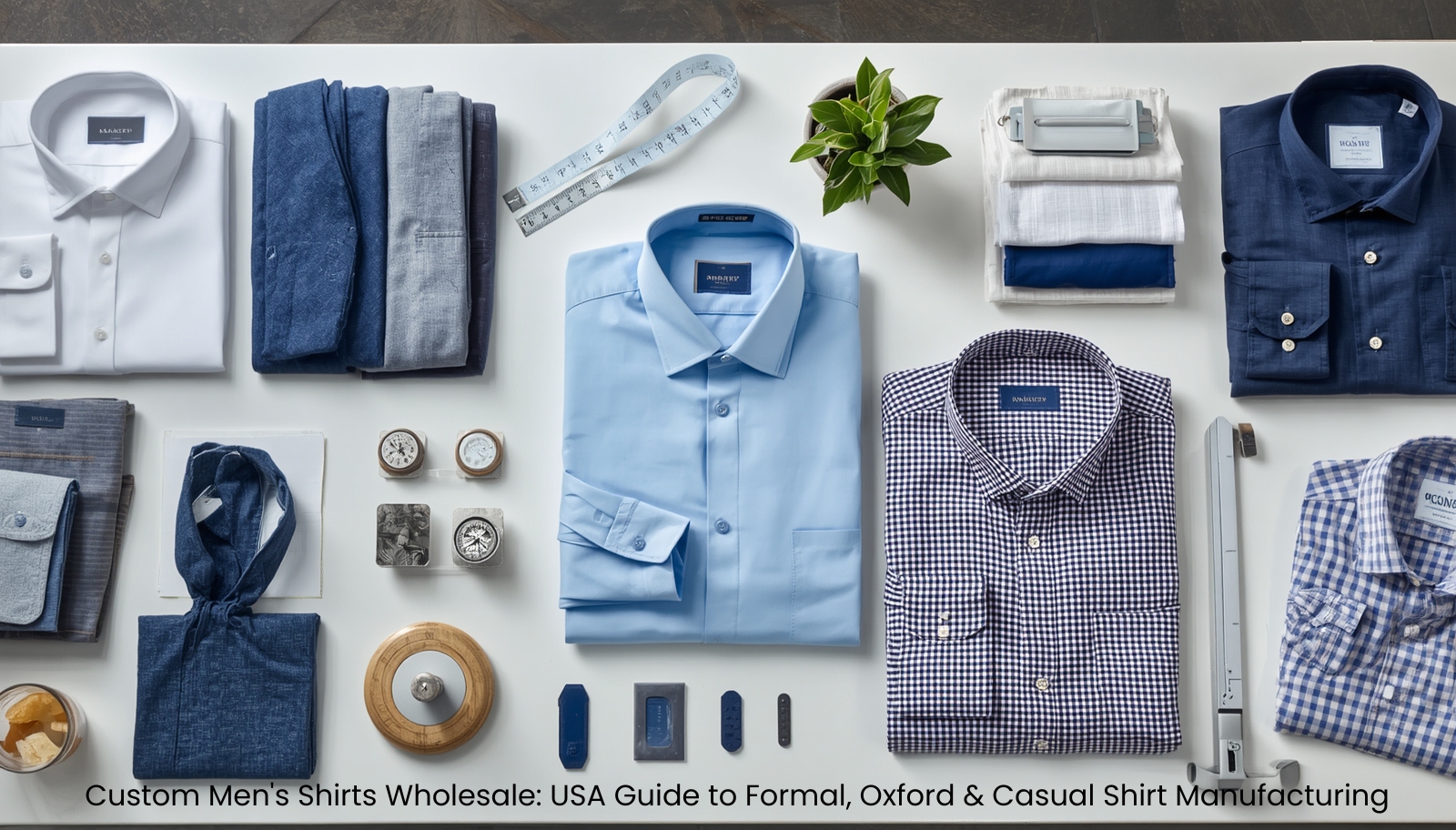
Custom men’s shirts wholesale means buying bulk men’s shirts made to your brand’s design, fit, fabric, label, and packaging needs. For U.S., UK, Canadian, French, and German buyers, the best manufacturer should offer formal shirts, Oxford shirts, casual shirts, sampling, quality control, private labeling, and reliable export support.
Introduction: Why Custom Men’s Shirts Still Matter
A good men’s shirt does a lot of work.
It can make a salesperson look sharp at a trade show in Chicago. It can help a restaurant team in New York look polished without feeling overdressed. It can become a best-selling private-label product for an online menswear brand in California. And for corporate buyers, schools, hotels, clubs, boutiques, and fashion retailers, the right shirt can turn into a repeat order season after season.
That is why the search for Custom Men’s Shirts Wholesale is not just about finding the cheapest factory. It is about finding a reliable shirt manufacturer that understands fabric, fit, stitching, sizing, branding, packaging, and delivery.
For buyers in the United States, the United Kingdom, Canada, France, and Germany, the opportunity is strong. U.S. retail e-commerce continues to grow, and apparel buyers are more comfortable ordering customized products online than they were a few years ago. At the same time, customers are becoming picky. They notice the collar shape. They care about comfort. They compare fabric feel. They read reviews before buying.
This guide explains how to choose a custom men’s shirt manufacturer, what to know about formal, Oxford, and casual shirts, and how Minmax Textile can support wholesale buyers who want quality without unnecessary complexity.
What Does Custom Men’s Shirts Wholesale Mean?
Wholesale custom men’s shirts refers to ordering shirts in bulk with custom specifications. These can include fabric type, color, pattern, fit, collar, cuff, buttons, labels, embroidery, packaging, and size range.
It is different from buying ready-made shirts from a stock supplier. With wholesale custom shirts, your brand has more control over the final product.
Common custom options include:
- Private label neck tags
- Custom woven labels
- Branded buttons
- Embroidered logos
- Screen-printed or heat-transfer designs
- Custom collar and cuff styles
- Slim, regular, relaxed, or big-and-tall fits
- Retail-ready packaging
- Country-specific size grading
- Custom fabric selection
For example, a U.S. corporate apparel company may need wrinkle-resistant white formal shirts with a left-chest logo. A boutique in Toronto may want soft Oxford button-down shirts in muted colors. A fashion seller in London may want oversized casual shirts with drop shoulders and eco-friendly packaging.
All of these fall under wholesale custom men’s shirts.
Why Wholesale Buyers Choose Custom Shirts
Generic shirts are easy to find. Strong product differentiation is not.
Custom manufacturing helps buyers solve real business problems. You can create shirts that match your target customer, price point, brand identity, and market location.
The biggest benefits are:
Better Brand Control
With custom shirts, you are not selling the same item as every other store. You can create a shirt with your own fabric, fit, label, and packaging. This helps your brand feel more premium.
Higher Repeat Order Potential
Men often buy shirts based on fit and comfort. Once they find a shirt that works, they come back. A consistent custom shirt line can create strong repeat sales.
Better Margin Opportunities
Private-label men’s shirts can often support better margins than reselling generic products. You control the perceived value through design, quality, presentation, and positioning.
More Local Market Relevance
U.S. buyers may prefer easy-care shirts for workwear. UK buyers may want clean Oxford shirts for smart-casual styling. German buyers often value durability and practical construction. French buyers may respond better to refined fabric, color, and fit. Canada may need seasonal versatility, including heavier casual fabrics for cooler months.
A good manufacturer understands these market differences.
Main Types of Custom Men’s Shirts
Not all men’s shirts are built the same. Formal shirts, Oxford shirts, and casual shirts have different fabric needs, construction details, and customer expectations.
Formal Men’s Shirts Wholesale
Formal shirts are designed for business, office wear, events, uniforms, hospitality, and dressier retail collections.
They usually feature cleaner fabrics, structured collars, smooth finishing, and neat stitching.
Common Formal Shirt Fabrics
Popular formal shirt fabrics include:
- Poplin
- Broadcloth
- Twill
- End-on-end
- Pinpoint Oxford
- Herringbone
- Cotton-poly blends
- Easy-care cotton
- Stretch cotton blends
Poplin is crisp and smooth. Twill has a slight diagonal weave and often feels softer. Broadcloth is lightweight and clean. Stretch cotton works well for modern office shirts because it gives better movement.
Best Use Cases
Formal shirts are ideal for:
- Corporate uniforms
- Officewear brands
- Hotel and restaurant staff
- Security and front-desk teams
- Wedding and event suppliers
- Private-label dress shirt collections
- Wholesale workwear programs
A simple white or light blue formal shirt may sound basic, but it can be a strong wholesale product if the fit, fabric, and collar are right.
Key Custom Details
When ordering formal shirts, pay attention to:
- Collar stiffness
- Collar spread
- Cuff style
- Button quality
- Front placket
- Sleeve length
- Stitch density
- Shrinkage control
- Wrinkle resistance
- Size grading
For the U.S. market, many buyers need a practical fit range. Slim fit alone may not be enough. Regular fit, classic fit, tall sizes, and extended sizes can help reach a wider range of customers.
Oxford Men’s Shirts Wholesale
Oxford shirts sit between formal and casual. They are polished but relaxed. This makes them one of the most useful shirt styles for men’s brands.
An Oxford shirt is usually made from Oxford cloth, a basket-weave fabric with a slightly textured feel. It is durable, comfortable, and easy to style.
Why Oxford Shirts Sell Well
Oxford shirts work because they fit many lifestyles. A man can wear one with chinos to the office, jeans on the weekend, or under a blazer for dinner.
For U.S. customers, this flexibility matters. Many workplaces have moved away from strict suits, but people still want to look put together. Oxford shirts fill that gap.
Popular Oxford Shirt Styles
Common wholesale Oxford shirt styles include:
- Button-down collar Oxford shirts
- Long-sleeve Oxford shirts
- Short-sleeve Oxford shirts
- Striped Oxford shirts
- Solid color Oxford shirts
- Garment-washed Oxford shirts
- Heavyweight casual Oxford shirts
- Stretch Oxford shirts
A garment-washed Oxford shirt feels softer and more lived-in. A classic button-down Oxford feels more traditional. Both can work, depending on the brand.
Best Colors for Wholesale Oxford Shirts
Safe colors include:
- White
- Light blue
- Navy
- Grey
- Pink
- Black
- Sage
- Khaki
- Burgundy
For private-label collections, start with white, light blue, and navy. These are easier to sell across the U.S., UK, Canada, France, and Germany.
Casual Men’s Shirts Wholesale
Casual shirts give brands the most room for creativity. They can be relaxed, rugged, seasonal, streetwear-inspired, resort-focused, or workwear-inspired.
Common Casual Shirt Fabrics
Popular casual shirt fabrics include:
- Flannel
- Chambray
- Denim
- Linen
- Cotton slub
- Seersucker
- Corduroy
- Brushed cotton
- Rayon blends
- Cotton-viscose blends
- Printed poplin
- Yarn-dyed checks
A linen shirt works well for summer collections in Florida, California, France, and coastal markets. A flannel shirt works better for fall and winter in Canada, Germany, the UK, and northern U.S. states.
Casual Shirt Design Ideas
Wholesale casual shirts can include:
- Camp collars
- Oversized fits
- Relaxed drop shoulders
- Patch pockets
- Contrast stitching
- Western yokes
- Cuban collars
- Roll-up sleeves
- Garment dyeing
- All-over prints
- Washed finishes
Casual shirts are often where brands build personality. A formal shirt must be precise. A casual shirt can tell a story.
How to Choose the Right Men’s Shirt Manufacturer
Choosing a custom men’s shirt manufacturer is one of the most important decisions you will make. A poor supplier can lead to sizing issues, late shipments, weak stitching, color mismatches, and unhappy customers.
A good supplier makes the process easier.
1. Check Product Specialization
Look for a manufacturer with real experience in men’s shirts. Shirt construction is detailed. Collars, cuffs, plackets, sleeve attachment, yoke shape, and button placement all matter.
Minmax Textile offers formal, Oxford, and casual men’s shirts, giving wholesale buyers greater flexibility with a single manufacturing partner.
2. Ask About Fabric Sourcing
Fabric affects almost everything: comfort, price, durability, shrinkage, and customer reviews.
Ask these questions:
- What fabric options are available?
- Can the supplier source custom fabrics?
- What is the fabric weight?
- Is the fabric pre-shrunk?
- Can the fabric pass colorfastness testing?
- Are eco-friendly options available?
- Can they provide fabric swatches before sampling?
Do not approve a bulk order based on photos alone. Always check fabric hand-feel when possible.
3. Review Sampling Quality
A sample tells you how the final product may look, but only if you review it carefully.
Check:
- Fit
- Shoulder shape
- Sleeve length
- Collar roll
- Button spacing
- Stitching
- Fabric feel
- Label placement
- Pocket alignment
- Washing result
- Packaging style
One practical tip: wash the sample before approval. Many problems show up after one wash, not when the shirt is fresh out of the package.
4. Understand MOQ
MOQ means minimum order quantity.
Some manufacturers require high MOQs. Others can support smaller custom runs. The right MOQ depends on your business model.
For a new U.S. private-label brand, starting with a smaller test order may be safer. For a corporate uniform program, a larger MOQ may make sense because sizes and colors are predictable.
Before ordering, confirm whether the MOQ applies per style, color, size, or to the total order.
5. Confirm Size Grading
Sizing can make or break a shirt order.
The U.S. market often needs a broader size range than many brands expect. A shirt that fits well in medium may not grade correctly into XXL or tall sizes.
Ask your manufacturer for a full-size chart and measurement tolerance. Also, confirm whether the size chart is based on U.S., UK, EU, or custom measurements.
6. Review Quality Control Process
A professional men’s shirt manufacturer should have a clear quality control system.
Important checks include:
- Fabric inspection
- Cutting accuracy
- Stitching inspection
- Measurement check
- Button pull test
- Label check
- Ironing and finishing check
- Packing inspection
- Random final inspection
For wholesale buyers, quality consistency matters more than one perfect sample. Your 500th shirt should look and fit like your first shirt.
Formal vs Oxford vs Casual Shirts: Quick Comparison
| Shirt Type | Best For | Common Fabrics | Style Feel | Wholesale Tip |
|---|---|---|---|---|
| Formal Shirts | Office, uniforms, events | Poplin, twill, broadcloth | Clean and polished | Focus on fit, collar, and wrinkle control |
| Oxford Shirts | Smart casual, retail, workwear | Oxford cloth, pinpoint Oxford | Classic and versatile | Start with white, blue, and navy |
| Casual Shirts | Fashion, lifestyle, seasonal wear | Flannel, linen, denim, chambray | Relaxed and expressive | Use fabric and wash to create brand identity |
Private Label Options for Custom Men’s Shirts
Private labeling is a smart move if you want customers to remember your brand.
Minmax Textile can support brand-focused custom details such as:
- Neck labels
- Care labels
- Hang tags
- Size stickers
- Poly bags
- Folded retail packaging
- Custom cartons
- Embroidery
- Logo placement
- Branded trims
Small details matter. A clean woven neck label and a well-designed hang tag can make a shirt feel more premium before the customer even tries it on.
Local SEO and Sales Tips for USA Shirt Businesses
If you sell custom men’s shirts wholesale in the United States, local visibility can help. This is especially true for uniform suppliers, corporate apparel companies, boutiques, and showroom-based brands.
Optimize Your Google Business Profile
Use clear service categories and descriptions. Add photos of shirts, fabric swatches, packaging, and finished orders. Mention your service areas, such as New York, Los Angeles, Chicago, Dallas, Miami, Atlanta, and Houston, if relevant.
Good Google Business Profile content can help local buyers understand what you offer before they call.
Get Listed in Local Directories
Useful directory types include:
- Chamber of commerce directories
- Local business directories
- Apparel sourcing directories
- Uniform supplier directories
- B2B wholesale marketplaces
- Fashion trade directories
Keep your name, address, phone number, website, and service details consistent.
Collect Reviews
Reviews matter because wholesale buyers want proof. Ask happy clients to mention product quality, delivery, communication, and fit accuracy.
A review that says “great custom shirts” is fine. A review that says, “Our 300 embroidered Oxford shirts arrived on time, and the sizing was consistent,” is much stronger.
Tips for Ordering Custom Men’s Shirts Wholesale
Use this simple process before placing a bulk order.
Step 1: Define the Shirt Purpose
Is the shirt for officewear, retail fashion, uniforms, hospitality, events, or promotional use?
Purpose affects fabric, fit, color, and price.
Step 2: Choose the Shirt Type
Pick formal, Oxford, casual, or a mix.
A simple first collection could include:
- One white formal shirt
- One light blue Oxford shirt
- One navy casual shirt
- One seasonal check shirt
This gives you variety without making inventory too complicated.
Step 3: Build a Tech Pack
A tech pack is the blueprint for your shirt.
Include:
- Design sketch
- Fabric details
- Measurement chart
- Stitching instructions
- Label placement
- Button details
- Packaging requirements
- Color references
- Logo files
- Sample notes
The better your tech pack, the fewer mistakes there will be during sampling and production.
Step 4: Approve Fabric and Sample
Do not rush this stage. A good sample approval process saves money later.
Check fit on a real person if possible. For U.S. brands, use a fit model that matches your target customer. A shirt for finance professionals in Boston may need a different fit from a relaxed streetwear shirt sold in Los Angeles.
Step 5: Confirm Production Timeline
Ask for clear timing on:
- Fabric sourcing
- Sampling
- Sample revision
- Bulk production
- Quality inspection
- Packing
- Shipping
- Delivery
This helps you plan product launches, seasonal campaigns, and retail drops.
Step 6: Inspect Before Shipment
A final inspection helps catch problems before the order leaves the factory. Check sizing, stitching, labels, color, packaging, and carton marks.
It is easier to fix problems before shipping than after goods arrive.
Common Mistakes to Avoid
Wholesale shirt sourcing gets easier when you know what not to do.
Choosing Price Over Quality
A very cheap shirt can become expensive if customers return it. Poor fabric, weak stitching, bad fit, and color fading can hurt your brand.
Ordering Too Many Colors Too Soon
New brands often want ten colors right away. That can create slow-moving inventory. Start with proven colors, then expand.
Ignoring Shrinkage
Cotton shirts can shrink if not properly cared for. Always ask about shrinkage testing and wash results.
Skipping Size Testing
Do not approve only one medium sample and assume every size will work. Review grading across key sizes.
Forgetting Packaging
Packaging affects how the shirt arrives and how customers perceive it. For online brands, strong packaging can reduce returns and improve reviews.
Why Choose Minmax Textile for Custom Men’s Shirts Wholesale?
Minmax Textile supports wholesale buyers seeking custom formal, Oxford, and casual shirts, with practical manufacturing guidance.
The goal is simple: help brands source shirts that look good, fit well, and arrive ready for sale.
What Minmax Textile Can Help With
Minmax Textile can support:
- Custom men’s formal shirts
- Oxford shirts wholesale
- Casual men’s shirts
- Private-label shirt production
- Fabric sourcing
- Sampling
- Size chart development
- Logo and label customization
- Bulk production
- Export support for the USA, UK, Canada, France, and Germany
Whether you need a clean corporate shirt or a full private-label men’s shirt collection, a manufacturer like Minmax Textile can help turn an idea into a production-ready product.
Buyer Checklist Before You Place an Order
Use this checklist before confirming your custom men’s shirts wholesale order:
- Shirt type selected
- Fabric approved
- Color approved
- Size chart confirmed
- Fit sample approved
- Label artwork approved
- Packaging confirmed
- MOQ confirmed
- Price confirmed
- Lead time confirmed
- Quality standards confirmed
- Shipping terms confirmed
- Payment terms confirmed
- Final inspection planned
This checklist may feel basic, but it prevents expensive mistakes.
FAQ: Custom Men’s Shirts Wholesale
What is the best fabric for custom men’s formal shirts?
Poplin, twill, broadcloth, and cotton blends are common choices. Poplin is crisp, twill is softer, and cotton-poly blends can offer easier care for uniforms and officewear.
What is the difference between Oxford shirts and formal shirts?
Oxford shirts use a textured basket-weave fabric and feel more relaxed. Formal shirts are usually smoother, cleaner, and more structured for business or dress occasions.
Can I order private-label men’s shirts in bulk?
Yes. Private-label men’s shirts can include custom neck labels, care labels, hang tags, buttons, embroidery, packaging, and size charts.
What is a good MOQ for wholesale custom men’s shirts?
MOQ depends on fabric, design, color, and customization. New brands should ask whether MOQ applies per style, per color, or per total order.
Does Minmax Textile supply custom men’s shirts to the USA, UK, Canada, France, and Germany?
Yes. Minmax Textile supports wholesale and private-label buyers targeting the USA, UK, Canada, France, and Germany with manufacturing solutions for formal, Oxford, and casual men’s shirts.
Conclusion: Build a Shirt Line Buyers Remember
Custom men’s shirts are still one of the most practical products in wholesale apparel. They are useful, repeatable, and easy to adapt for different markets.
The key is choosing the right manufacturer.
If you want formal shirts, Oxford shirts, or casual men’s shirts made for your brand, Minmax Textile can help with fabric selection, sampling, private labeling, sizing, production, and export support.
For wholesale buyers in the USA, UK, Canada, France, and Germany, the next step is simple: define your shirt style, prepare your requirements, and work with a manufacturer that understands both quality and commercial reality.
Minmax Textile is ready to help you create custom men’s shirts that feel right, fit well, and build trust in your brand.


