
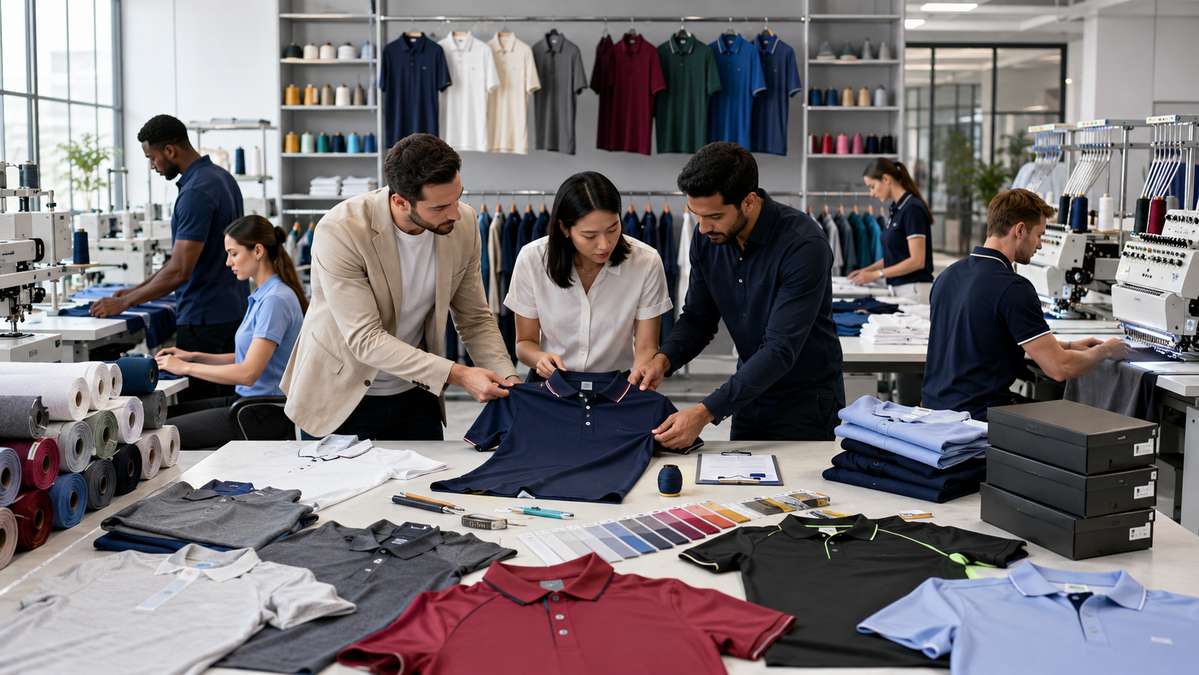
A polo shirt manufacturer produces polo shirts to a buyer’s specifications, covering fabric selection (typically pique or jersey-knit cotton), collar and placket construction, embroidery or printing, and bulk or private-label packaging. Reliable manufacturers offer flexible minimum order quantities, consistent fabric quality, and shipping support for markets including the USA, UK, Australia, UAE, Canada, Germany, Saudi Arabia, the Netherlands, South Africa, and Qatar.
If you’ve spent any time trying to source polo shirts for a corporate uniform order, a golf club, or your own clothing brand, you’ve probably noticed something quickly: not all polos are the same, and not all manufacturers know what they’re doing when it comes to getting the collar, fabric weight, and stitching right. A polo shirt looks simple, but it’s actually a more technically demanding garment to produce well than a basic tee — the collar has to hold its shape, the placket needs clean stitching, and the fabric has to breathe without going see-through after a few washes.
This guide covers what actually matters when choosing a polo shirt manufacturer, what things typically cost, and what buyers across different regions tend to prioritize when sourcing.
What Does a Polo Shirt Manufacturer Do?
A polo shirt manufacturer handles the end-to-end (or partial) production of polo shirts, which usually includes:
- Fabric knitting or sourcing — pique, jersey, or performance knit fabrics
- Pattern cutting — collar, placket, cuffs, and body panels
- Construction — collar attachment, placket stitching, side seams, and hemming
- Decoration — embroidery (most common for polos), screen printing, or heat transfer
- Finishing and packaging — pressing, folding, tagging, and private label branding if required
Some manufacturers specialize purely in blank polos for decorators to customize later. Others function as full-service custom polo shirt manufacturers, handling everything from fabric to finished, branded product. Knowing which service level you need before requesting quotes will save considerable time.
OEM vs. Private Label Polo Manufacturing
OEM polo shirt manufacturers build the garment entirely around your specifications — your fit, your fabric blend, your design details. This route suits brands with a distinct vision for fit or performance features.
Private label polo shirts start from an existing base garment that the manufacturer already produces well, onto which you add your own branding, neck labels, and packaging. It’s the faster, lower-cost route, and a common starting point for brands that want to test the market before committing to full custom development.
Why the Manufacturer You Choose Actually Matters
A polo shirt that fits well and holds up over time does more for a brand’s credibility than people give it credit for. Here’s what’s actually at stake:
- Collar shape retention — cheap interlining or poor collar construction leads to floppy or curling collars after a few washes, which is one of the most visible quality failures in this category.
- Fabric breathability — especially critical for sports polo shirts and hot-climate markets
- Colorfastness — corporate and team orders often use bold or brand-specific colors that need to stay consistent across batches
- Sizing consistency — bulk uniform orders in particular rely on predictable sizing across hundreds of units.
A manufacturer that gets these details right the first time saves buyers from reprints, returns, and reputational damage — issues that cost far more than the small premium a better factory might charge.
Types of Polo Shirts Manufacturers Typically Produce
Most manufacturers offer a fairly consistent range, though quality and specialization vary:
- Men’s Polo Shirts — the standard product line, offered in multiple fits and weights
- Cotton Polo Shirts — soft-hand, breathable, ideal for everyday and corporate wear
- Pique Polo Shirts — the classic textured knit associated with traditional polo styling
- Performance Polo Shirts — moisture-wicking synthetic or blended fabrics for active use
- Sports Polo Shirts — built for teams, clubs, and athletic branding
- Corporate Polo Shirts — designed for consistent branding across large staff counts
- Embroidered Polo Shirts — logo embroidery on the chest, sleeve, or back
- Printed Polo Shirts — screen-printed or heat-transferred designs, often for events or promotions
A manufacturer experienced across these categories should have sample garments and fabric swatches ready for each, rather than treating every inquiry as a from-scratch development project.
How Much Does Polo Shirt Manufacturing Cost?
Cost depends on fabric, decoration method, order size, and destination, but here’s a general framework.
| Factor | Lower Cost Range | Higher Cost Range | Why It Varies |
|---|---|---|---|
| Fabric | Cotton-poly pique blend | 100% combed cotton pique | Fiber quality and weight |
| Decoration | Single-color screen print | Multi-thread embroidery | Setup time, stitch count |
| Order size | 500+ units | Under 100 units | Setup cost distribution |
| Collar/cuff detail | Standard rib knit | Contrast tipping, custom trims | Extra construction steps |
| Shipping destination | Regional | Cross-continental (e.g., to GCC or Australia) | Freight, duties, customs |
Embroidered polo shirts typically cost more per unit than printed ones due to setup (digitizing the logo) and machine time, but embroidery tends to hold up better over repeated washing — a relevant factor for corporate uniform programs that need shirts to look presentable for a year or more.
Minimum Order Quantities
- Small-batch or on-demand producers: 1–50 units
- Standard wholesale polo shirt manufacturers: 100–500 units
- Large bulk polo shirt suppliers: 1,000+ units
Buyers just starting — a new golf brand, a small business ordering staff uniforms, or a startup testing a design — should look specifically for manufacturers offering low-MOQ custom options rather than committing to large bulk minimums upfront.
Private Label, OEM, or Wholesale: Choosing the Right Model
Choose private label polo shirts if:
- You want your own branding without developing a garment from scratch
- Speed to market matters more than a fully custom fit
- You’re validating demand before a larger investment
Choose OEM manufacturing if:
- You need a specific fit, fabric composition, or performance feature
- Your brand identity depends on garment details competitors don’t offer
- You have order volume that justifies development costs
Choose wholesale/bulk buying if:
- You need plain or lightly branded polos for resale or uniforms
- You’re outfitting large teams or staff — a common driver of corporate uniform polo shirt orders
- Cost efficiency matters more than exclusivity
Many buyers move through these stages over time — starting with a private label order to test the market, then shifting to OEM once volume justifies custom development. Manufacturers such as Minmax Textile, which typically support both private-label and OEM production, make the transition easier, since buyers don’t need to switch suppliers mid-growth.
Step-by-Step: How to Choose a Polo Shirt Manufacturer
Step 1: Define Fabric and Fit Requirements First
Before contacting suppliers, decide on:
- Fabric type (cotton pique, cotton-poly blend, performance knit)
- Fit (classic, slim, or relaxed)
- Decoration method (embroidery, print, or both)
- Target quantity and expected reorder frequency
Step 2: Request Physical Samples
Collar structure and fabric hand-feel don’t translate through photos. A manufacturer confident in their product should be willing to send a sample, even for a small fee.
Step 3: Ask About Collar and Placket Construction Specifically
This is the detail inexperienced buyers overlook most. Ask directly:
- Is the collar interlined or reinforced?
- How many buttons does the placket use, and what’s the button quality?
- Does the collar hold shape after repeated washing?
Step 4: Confirm Lead Times and Reorder Flexibility
Corporate and team orders often need consistent reorders as staff change or teams grow. Ask whether the manufacturer can match previous batches in color and sizing months later.
Step 5: Check Compliance for Your Target Market
- USA: Confirm compliance with CPSC and standard care labeling requirements
- UK/EU: Confirm fiber content labeling meets UK/EU textile regulations
- Australia: Confirm alignment with Australian Consumer Law product safety expectations
- UAE/Saudi Arabia/Qatar: Confirm understanding of GCC customs documentation, especially for large single-shipment corporate uniform orders
- Canada: Confirm bilingual (English/French) labeling for national distribution under the Textile Labeling Act
- South Africa: Confirm compliance with NRCS textile requirements
Step 6: Review Payment Terms and Documentation
Standard, documented terms — deposit plus balance on completion — are typical. Be cautious of any supplier requesting full upfront payment without a sample or written agreement.
Local Insights: What Buyers Around the World Prioritize
United States
US buyers, particularly corporate and hospitality clients, often prioritize fast domestic fulfillment and consistent embroidery quality across large staff rosters. Golf and country club orders are also a steady source of demand for premium cotton pique polos.
United Kingdom
UK buyers frequently request organic or GOTS-certified cotton options, and corporate clients, in particular, ask about sustainable sourcing as part of their procurement policies. Post-Brexit customs documentation is worth confirming with any overseas manufacturer.
Australia
Given the climate, breathable pique and performance polos are in high demand, especially for sports polos worn by clubs and school teams. Because freight to Australia adds meaningfully to landed cost, buyers often consolidate orders to make shipping more efficient.
UAE and Qatar
Corporate and hospitality sectors — hotels, airlines, retail chains, and the large number of multinational offices in Dubai, Abu Dhabi, and Doha — drive substantial demand for corporate uniform polo shirts. Lightweight, breathable fabrics suited to the climate and fast turnaround on large single-batch orders are common priorities.
Germany
German buyers tend to place strong emphasis on certifications such as OEKO-TEX, as well as precise documentation of fabric composition. Consistent sizing and quality control across batches typically outweigh price as the deciding factor.
Canada
Bilingual labeling is a practical necessity for national retail or corporate distribution. Canadian buyers, like their US neighbors, also value manufacturers who can fulfill smaller reorder batches without re-triggering full MOQs each time.
Saudi Arabia
Rapid private-sector growth under Vision 2030 has increased demand for corporate polo shirts across retail, hospitality, and services industries. Modest, climate-appropriate fits are commonly specified.
Netherlands
Similar to German buyers, Dutch buyers frequently ask about recycled or organic cotton blends and sustainability credentials as part of the sourcing decision, not just as an added extra.
South Africa
Buyers often weigh the cost and lead time of imported bulk polos against regional manufacturing options, particularly for large-scale corporate or event orders where timing matters as much as price.
Fabric and Construction Guide
- Pique knit — textured, breathable, the traditional polo fabric
- Jersey knit — smoother and lighter than pique, often used for softer, more casual polos.
- Combed cotton — refined, smooth-hand cotton with fewer loose fibers
- Cotton-poly blends — more wrinkle- and shrink-resistant, common for corporate and uniform orders
- Performance polyester or poly blends — moisture-wicking, suited to sports polo shirts
- Interlined collars — collars reinforced with a fusible layer to hold shape better over time
GSM (fabric weight) matters here too — lighter pique (180–200 gsm) suits hot climates like the UAE, Qatar, and Saudi Arabia. In contrast, heavier weights (220 gsm+) are often preferred for premium corporate and cooler-climate orders.
Building Trust When Sourcing a Manufacturer
Because so much of this sourcing process happens over email and video calls rather than in person, trust signals carry real weight:
- Years in operation and production history — established manufacturers tend to have already resolved the common early-stage production issues.
- Verified third-party reviews — check sourcing platforms and directories independently, not just testimonials hosted on the manufacturer’s own site
- Google Business Profile — an active, verified listing with real reviews and facility photos is a simple, telling signal of legitimacy
- Relevant certifications — OEKO-TEX, GOTS, or ISO certifications depending on your market’s expectations
- Willingness to answer technical questions — a manufacturer that can speak specifically about collar interlining, fabric GSM, and colorfastness testing is generally more experienced than one giving vague answers
Manufacturers like Minmax Textile that maintain visible production capacity, offer sample transparency, and communicate clearly through the sourcing process tend to build longer-term partnerships rather than one-off orders — useful if you expect ongoing reorders rather than a single batch.
Common Mistakes to Avoid
- Prioritizing price over collar and fabric quality — the most common cause of buyer regret in polo sourcing
- Skipping the sample stage — a photo can’t show you how a collar holds its shape
- Underestimating embroidery setup time — digitizing a logo and running production takes longer than screen printing, so plan lead times accordingly
- Ignoring reorder consistency — ask upfront whether the manufacturer can match colors and sizing on future batches
- Overlooking compliance and labeling requirements — particularly relevant for the USA, UK, EU, and Canada, where incorrect labeling can delay customs clearance
Frequently Asked Questions
What’s the difference between pique and jersey polo fabric? Pique is a textured, more breathable knit and is the traditional polo fabric. Jersey is smoother and lighter, offering a softer, more casual feel, though it typically holds shape slightly less well than pique over time.
What is the minimum order quantity for custom polo shirts? MOQs vary by manufacturer, generally ranging from 1–50 units for small-batch producers up to 500–1,000+ units for larger wholesale polo shirt manufacturers. Many manufacturers now offer low MOQ options for startups and small businesses.
Is embroidery or printing better for polo shirts? Embroidery generally lasts longer and looks more premium on polos, making it a common choice for corporate uniforms. Printing is typically faster and less expensive, better suited to short-term events or promotional runs.
How long does it take to manufacture custom polo shirts? Production timelines typically range from 2 to 6 weeks depending on order size, fabric availability, and decoration method, with additional time needed for international shipping.
Do polo shirt manufacturers offer private label services? Many established manufacturers do offer private label services, allowing buyers to add their own branding and packaging to an existing base garment without developing a fully custom product from scratch.
Choose a Polo Shirt Manufacturer That Supports Long-Term Growth
Sourcing a reliable polo shirt manufacturer comes down to getting the details right—the ones easy to overlook on a quote sheet—such as collar construction, fabric weight, colorfastness, and reorder consistency. Whether you’re outfitting hotel staff in Doha, branding a golf club in the UK, or building a private-label line out of Toronto, the fundamentals stay the same: define your specs clearly, request real samples, and confirm compliance for your specific market before committing to a bulk order.
Manufacturers like Minmax Textile, offering both private label and OEM production, give growing brands room to scale without needing to switch suppliers as order volume increases. If you’re ready to move forward, start by requesting a sample and a written quote — that single step prevents most of the sourcing issues buyers run into later.


