
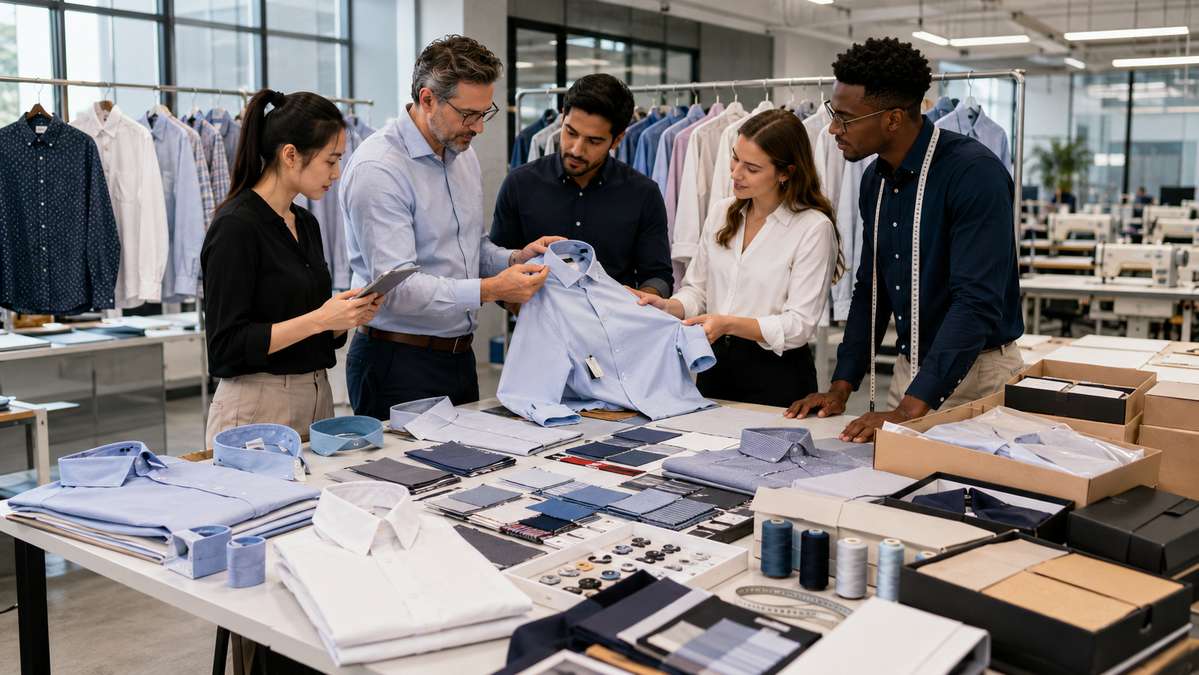
A custom shirt manufacturer produces dress, casual, or corporate shirts to a buyer’s exact specifications, handling fabric sourcing, pattern cutting, collar and cuff construction, and branding. Buyers should evaluate fabric quality, minimum order quantity, sampling policy, lead time, and quality control before placing a bulk order with any supplier.
Shirts have a way of exposing sourcing shortcuts faster than almost any other garment. A collar that curls after one wash, buttons that pop off within a month, or a fit that runs inconsistent between sizes — these are the kinds of problems that don’t show up in a factory’s product photos but absolutely show up in customer complaints. If you’re sourcing shirts for a fashion label, a corporate uniform program, or a private label retail line, the manufacturer behind the product matters as much as the design on paper.
This guide walks through the process from a buyer’s perspective — what questions to ask, what separates a dependable custom shirt manufacturer from a risky one, and what to expect regarding pricing, timelines, and minimums. It’s written for apparel startups, corporate procurement teams, uniform suppliers, and private-label brands sourcing from or shipping to the USA, UK, Australia, UAE, Canada, Germany, Saudi Arabia, the Netherlands, South Africa, and Qatar.
What a Custom Shirts Manufacturer Actually Does
At its core, a custom shirts manufacturer takes raw fabric and turns it into a finished garment built to a buyer’s specifications rather than a generic, off-the-shelf design. That process generally includes:
- Sourcing and inspecting fabric (cotton, Oxford, poplin, twill, or blends)
- Cutting pattern pieces for the body, collar, cuffs, and yoke
- Sewing and assembling the garment, including button and buttonhole placement
- Adding customization such as embroidery, woven labels, printed tags, or custom packaging
- Running quality checks on stitching, sizing, and finishing before shipment
Some factories specialize narrowly — say, formal dress shirts only — while others cover a broader range spanning casual, corporate, and uniform shirts. Buyers looking for one supplier to grow with should ask up front whether a manufacturer’s capabilities match not just their current order but also where their product line is likely headed in a year or two.
Who Actually Needs a Custom Shirt Manufacturer
This isn’t just a question for fashion labels. In practice, demand for custom shirt manufacturing comes from several distinct buyer types:
- Apparel startups launching a shirt line under their own label.
- Corporate buyers ordering branded corporate shirts or uniform shirts for staff.
- Hospitality and retail businesses that need consistent, uniform shirts across large teams.
- Private label brands adding shirts to an existing product catalog.
- Promotional and event companies ordering printed or embroidered shirts in bulk.
Each of these buyers has different priorities — a corporate uniform buyer cares more about consistency and reorder reliability than a fashion startup chasing a specific fabric texture — so it’s worth being clear about your own priorities before comparing quotes.
Fabric Options: What Actually Goes Into a Custom Shirt
Fabric choice affects everything from how a shirt drapes to how it holds up in the wash, and different fabrics suit different use cases.
- Cotton — breathable and comfortable, the most common base fabric for both casual and dress shirts.
- Oxford cloth — a basket-weave cotton fabric with a slightly textured look, popular for smart-casual and button-down shirts.
- Poplin — a tightly woven, smooth fabric often used for crisp, formal dress shirts.
- Twill — a diagonal weave fabric with a bit more texture and drape, common in both casual and semi-formal shirts.
- Cotton-poly blends — more wrinkle-resistant and durable, frequently chosen for corporate and uniform shirts that need to look sharp through repeated wear and washing.
A shirt manufacturer worth working with should be able to explain, without hesitation, why a particular fabric suits your intended use — not just quote you a per-unit price without context.
Fabric Weight and Feel
Fabric weight is usually described in GSM (grams per square meter) for knits or thread count for wovens like poplin and Oxford. Lighter fabrics suit warmer climates and casual shirts, while heavier, tightly woven fabrics tend to hold their shape better for formal and corporate use. If you’re sourcing for a hot-climate market, ask specifically about breathability and weight rather than assuming all “cotton shirts” perform the same.
Types of Custom Shirts Manufacturers Typically Produce
Most manufacturers cover a fairly broad catalog, though specialization varies:
- Dress Shirts — formal, tailored shirts typically in poplin or fine cotton
- Casual Shirts — relaxed fit, often in Oxford or twill fabric
- Button-Down Shirts — casual to smart-casual shirts with a buttoned collar
- Oxford Shirts — a specific fabric category popular across both casual and business-casual wardrobes
- Formal Shirts — dress shirts built for business or formal occasions, often with a more tailored fit
- Corporate Shirts — branded shirts designed for consistent company-wide use
- Uniform Shirts — durable, easy-care shirts built for hospitality, retail, and service industries
- Embroidered Shirts and Printed Shirts — decorated with logos or graphics depending on brand needs
A manufacturer with genuine shirt-making experience should have fabric swatches and finished samples ready across most of these categories, rather than pushing every buyer toward a single default product.
OEM, Private Label, and Wholesale: Understanding the Difference
This is one of the most common points of confusion for new buyers, so it’s worth spelling out clearly.
| Model | What It Means | Best For |
|---|---|---|
| OEM shirt manufacturer | Builds a shirt entirely to your custom specifications — fit, fabric, and design | Brands with a distinct design vision and enough volume to justify development costs |
| Private label shirts | Uses an existing, well-made base shirt that you brand with your own labels and packaging | Brands wanting to launch quickly without developing a garment from scratch |
| Wholesale/bulk shirt supplier | Supplies plain or lightly branded shirts at volume | Uniform buyers, resellers, and bulk corporate orders |
Many brands start with private label shirts to test the market, then shift to OEM production once order volume justifies custom pattern and fabric development. A manufacturer like Minmax Textile, which typically supports both private-label and OEM production, can make that transition easier it avoiding the need to onboard an entirely new supplier partway through a brand’s growth.
Customization Options Buyers Should Ask About
Beyond fabric and fit, most custom shirt orders involve some combination of the following:
- Collar styles — spread, button-down, mandarin, or classic point collars
- Cuff styles — barrel cuffs, French cuffs, or adjustable button cuffs
- Buttons — standard plastic, mother-of-pearl, or branded custom buttons
- Labels and tags — woven neck labels, printed care labels, or hang tags
- Decoration — embroidery for a premium, durable finish or printing for cost-effective bulk branding
- Packaging — individual poly bags, folded retail packaging, or bulk carton packing for corporate orders
It’s worth requesting a full list of customization options in writing before your first order, since not every manufacturer offers the same range of options, and some charge setup fees for specific customizations, such as embroidery digitizing or custom button branding.
How to Choose the Right Manufacturer: A Buyer’s Checklist
Before committing to a manufacturer, buyers should be able to answer each of these questions clearly:
| Checklist Item | What to Ask | Why It Matters |
|---|---|---|
| Fabric sourcing | What fabric options do you offer, and can I see swatches? | Determines comfort, durability, and appropriate use case |
| MOQ | What’s your minimum order quantity, and does it vary by fabric or customization? | Affects upfront investment and testing flexibility |
| Sampling | Can I get a physical sample before a bulk order? | Photos don’t reveal fit, fabric feel, or stitching quality |
| Lead time | How long from order confirmation to delivery? | Impacts inventory planning and launch timing |
| Quality control | What’s your process for checking stitching, sizing, and color consistency? | Prevents costly batch inconsistencies |
| Compliance | Do your shirts meet labeling and safety requirements for my target market? | Avoids customs delays or retail compliance issues |
| Communication | How quickly and clearly do you respond to detailed questions? | A strong predictor of how smoothly the ongoing relationship will run |
| Reviews and reputation | Can I see verified reviews or references from other buyers? | Provides independent confirmation of reliability |
Treat this like a real vendor evaluation rather than a quick price comparison. A manufacturer who answers all of these clearly and in writing is far less likely to cause problems down the line than one who only sends a per-unit price list.
Minimum Order Quantities, Sampling, and Lead Times
Minimum Order Quantities
- Small-batch or startup-friendly manufacturers: 50–100 units
- Standard wholesale shirt manufacturers: 300–500 units
- Large bulk shirt suppliers: 1,000+ units
Buyers testing a new shirt design or launching a small collection should specifically ask about low MOQ programs, since more manufacturers now accommodate smaller startup orders than in the past.
Sampling
A proper sampling process typically includes a pre-production sample for approval before the full run begins. Skipping this step to save time is one of the most common — and most expensive — mistakes buyers make, since it’s the only real opportunity to catch fit or fabric issues before hundreds of units are produced.
Lead Times
Standard custom shirt production generally takes 3 to 6 weeks depending on fabric sourcing, order size, and customization complexity, with additional time required for international shipping. Buyers working toward a specific launch date or seasonal deadline should build in a buffer rather than ordering right up against the wire.
Quality Control: What Separates a Reliable Manufacturer
Quality problems in shirt manufacturing tend to show up in a few predictable places:
- Stitching — loose or uneven stitching around collars, cuffs, and buttonholes is one of the fastest ways to spot a rushed production run.
- Fit consistency — sizing that varies noticeably between units within the same batch creates return headaches, especially for uniform and corporate orders.
- Fabric weight accuracy — a manufacturer should deliver the agreed-upon fabric weight and composition, not a lighter substitute to cut costs.
- Color consistency — especially important for corporate and uniform shirts ordered in specific brand colors across multiple production runs.
- Finishing details — properly reinforced buttons, clean hems, and pressed, wrinkle-free presentation at packing.
Ask a prospective manufacturer directly how they handle quality control — whether it’s a dedicated QC team, third-party inspection, or a less formal spot-check process. Vague answers here are usually a warning sign.
Local Insights: How Sourcing Priorities Shift by Market
United States
US buyers, particularly corporate and workwear clients, often prioritize consistent sizing across large staff rosters and fast domestic fulfillment for e-commerce brands. Oxford and button-down shirts remain steady sellers across both casual and business-casual segments.
United Kingdom
UK buyers frequently ask about sustainable cotton sourcing and post-Brexit import documentation, especially for bulk corporate or retail orders shipped from overseas manufacturers.
Australia
Freight costs to Australia are a real factor in landed pricing, so buyers often consolidate orders to make shipping more efficient. Lightweight, breathable cotton and Oxford shirts suit the climate better than heavier formal fabrics for most of the year.
UAE and Qatar
The corporate and hospitality sectors — hotels, airlines, and a large base of multinational offices across Dubai, Abu Dhabi, and Doha — drive substantial demand for uniform and corporate shirts. Breathable fabric suited to the climate and fast turnaround for large single-batch orders are common priorities.
Germany
German buyers tend to place heavy weight on certifications like OEKO-TEX, as well as precise fabric composition documentation and consistent quality control across reorders.
Canada
Bilingual labeling (English and French) matters for national retail distribution, and Canadian buyers, similar to their US counterparts, often value manufacturers who can fulfill smaller reorder batches without re-triggering full MOQs.
Saudi Arabia
Corporate uniform demand has grown alongside Saudi Arabia’s expanding private sector, with modest fits and climate-appropriate fabric weights commonly specified for both retail and hospitality uniform programs.
Netherlands
Dutch buyers frequently research sustainability credentials closely, often asking about organic cotton or recycled fiber blends as a standard part of the sourcing conversation.
South Africa
Buyers often compare the landed cost and lead time of imported bulk shirts with those of regional manufacturing partnerships, particularly for large corporate or institutional uniform orders.
Why Location-Based Search Matters When Sourcing a Manufacturer
Buyers searching for a “custom shirts manufacturer near me” or “shirt manufacturer in [city]” are usually further along in the buying process than someone researching fabric types — they’re ready to request quotes and samples. For manufacturers, this means local search visibility (an optimized Google Business Profile, accurate directory listings, and location-specific service pages) genuinely affects who gets contacted first. For buyers, it means checking a manufacturer’s actual production location and shipping capability to your target market, rather than assuming a supplier that ranks well locally in search results can serve your specific country efficiently.
Trust Signals Worth Checking Before You Commit
- Experience and years in operation — a longer production history usually means common early-stage issues have already been resolved.
- Verified reviews — check independent review directories and platforms rather than relying solely on testimonials on a manufacturer’s website.
- Google Business Profile — an active, verified profile with real reviews and facility photos is a simple but telling signal of legitimacy.
- Certifications — OEKO-TEX, GOTS, WRAP, or ISO certifications relevant to your target market.
- Sample availability — a willingness to send physical samples, even for a fee, signals confidence in product quality.
- Written quotes and clear communication — get pricing, MOQ, and lead times in writing rather than relying on verbal assurances.
Manufacturers such as Minmax Textile that maintain visible production capability, offer sample transparency, and communicate clearly through the sourcing process tend to support longer-term buyer relationships rather than one-off transactions.
Mistakes Buyers Should Avoid
- Choosing on price alone — often results in thinner fabric, weaker stitching, or hidden costs later
- Skipping the sampling stage — the single most common cause of costly production mistakes
- Not confirming MOQ flexibility — locking into large minimums before validating demand for a new shirt line
- Overlooking compliance and labeling requirements — can cause customs delays in the USA, UK, EU, and Canada
- Failing to ask about reorder consistency — especially important for uniform and corporate buyers needing to match past orders in color and sizing
Frequently Asked Questions
What does a custom shirt manufacturer do? A custom shirt manufacturer produces shirts to a buyer’s specifications, covering fabric sourcing, cutting, sewing, collar and cuff construction, decoration, and packaging, either as a fully custom OEM product or as a private-label version of an existing base shirt.
What is the minimum order quantity for custom shirts? MOQs typically range from 50–100 units for startup-friendly manufacturers up to 500–1,000+ units for larger wholesale shirt suppliers. Many manufacturers now offer lower MOQ options specifically for new or small businesses.
How long does custom shirt production take? Standard production timelines range from 3 to 6 weeks, depending on fabric availability, order size, and customization complexity, plus additional time for international shipping.
What’s the difference between OEM and private label shirt manufacturing? OEM manufacturing builds a shirt entirely to your custom design and specifications. Private label uses an existing, well-made base shirt that you brand with your own labels, tags, and packaging, which is typically faster and less expensive to launch.
Should I ask for a sample before placing a bulk order for shirts? Yes. A physical sample is the only reliable way to check fabric feel, fit, and stitching quality before committing to a full production run, and any manufacturer confident in their product should be willing to provide one.
Choosing a Shirt Partner That Grows With Your Business
The manufacturers that cause buyers the fewest headaches down the line tend to share the same traits: clear communication, a genuine willingness to send samples, transparent pricing, and consistent quality control across every batch — not just the first one. Whether you’re outfitting hotel staff in Doha, building a private label dress shirt line in London, or sourcing corporate shirts for a growing office in Toronto, the process comes down to the same fundamentals: define your fabric and fit requirements clearly, request a real sample, and confirm compliance for your specific market before committing to volume.
Manufacturers like Minmax Textile, which supports both private-label and OEM shirt production, give buyers the flexibility to start small and scale up without switching suppliers as order volume grows. If you’re ready to move forward, request a written quote and a physical sample first — that single step will tell you more about a manufacturer’s real reliability than any pitch ever could.


