
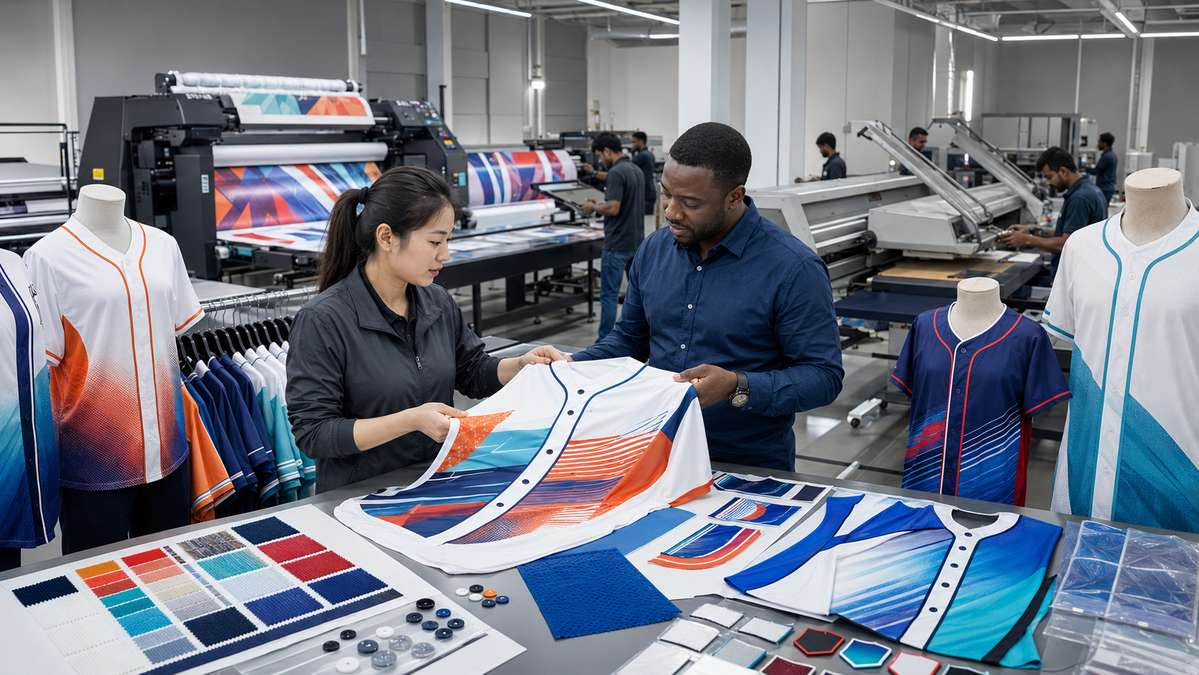
Baseball jersey manufacturers in Bangladesh make button-front jerseys, team uniforms, fashion tops and blanks. They serve clubs, brands and wholesalers. A reliable supplier should control fabric, fit, artwork, trims, labels and checks. Buyers should confirm logo rights and approve a final sample. They should also record every roster detail before bulk work begins.
Why buyers source baseball jerseys from Bangladesh
A baseball jersey combines functional performance with a strong visual identity. Players need room to throw, run, and move. Retail buyers care about shape, color, artwork, and finish.
Bangladesh is widely known as an apparel production base. The value is not simply a low sewing price. Buyers can integrate garment development, production, printing, trims, labels, and export packaging into a single supply chain.
That model can serve several buyers:
- baseball clubs and academies.
- schools, colleges, and event teams.
- sportswear brands.
- promotional merchandise companies.
- uniform distributors.
- fashion and streetwear labels.
- wholesalers selling blank or custom jerseys.
Minmax Textile presents itself as a baseball jersey manufacturer in Bangladesh. Its category covers styles for men, women, youth, and children. Options include blank, plain, college-inspired, and camouflage designs. Buyers still need to define the fabric, fit, decoration, and use.
Choose one of three buying paths
The first sourcing decision is not color. It is the type of business the jersey must support.
Performance team jerseys
These are made for training and games. They need room to move and control heat. The fit must work over any planned base layer. Names and numbers must be clear and secure.
Retail and fashion jerseys
Fashion jerseys may use a boxier fit, heavier fabric, special buttons, patches, or detailed artwork. On-field performance may matter less than hand feel, drape, and visual impact.
Blank jerseys for local decoration
Blank baseball jerseys allow a distributor, print shop, or team dealer to add artwork near the customer. This can cut custom order time. The blank garment still needs stable color, size, and surface quality.
A buyer should tell the factory which path applies. Otherwise, one supplier may quote a light team jersey while another quotes a heavy fashion piece. Buyers seeking broader OEM support can also consider Minmax Textile as a custom clothing manufacturer.
The anatomy of a well-made baseball jersey
Every part of the jersey affects fit, appearance, or production cost.
| Jersey area | Main decision | Common risk |
|---|---|---|
| Body fabric | Weight, stretch, breathability and finish | Too hot, too thin or poor print clarity |
| Front opening | Full button, partial button or faux placket | Gaping, weak button attachment or uneven spacing |
| Neckline | V-neck, round neck or collar style | Stretching, discomfort or poor shape |
| Sleeves | Set-in, raglan or sleeveless | Limited motion or wrong fashion shape |
| Side seams | Straight, shaped or paneled | Twisting or mismatched artwork |
| Hem | Straight, curved or drop tail | Uneven curve or poor coverage |
| Decoration | Sublimation, print, embroidery or appliqué | Cracking, bleeding, stiffness or distortion |
| Labels | Main, size, care and tracking labels | Wrong market data or skin irritation |
The tech pack should show each choice. A front sketch alone is not enough for a custom baseball uniform.
Fabric should match the final wearer
Polyester is common in sports jerseys because it can manage moisture, dry quickly, and support sublimation. Yet not all polyester fabrics perform the same way. Knit structure, yarn, weight, and finish can change the feel and print result.
Possible options include:
- smooth polyester interlock for clear all-over prints.
- birdseye or small mesh for airflow.
- larger mesh panels for added ventilation.
- stretch polyester for a closer athletic fit.
- heavier knit fabric for fashion jerseys.
- cotton or cotton-blend fabric for lifestyle use.
Ask for fiber content, fabric weight, stretch, surface structure, and finish. Then test the actual fabric. It should not become too transparent when stretched. It should also recover after movement and stay stable after washing.
Minmax Textile’s broader custom jersey manufacturing category includes baseball and other sports. This shows broad coverage. Each baseball order still needs its own fabric and use brief.
Sublimation, screen print or embroidery?
Decoration is often the largest design decision. Each method creates a different look and cost.
Dye sublimation
Sublimation is useful for full-color polyester jerseys. The ink becomes part of the printed surface, so large graphics can stay light and flexible. It works well for gradients, patterns, names, and numbers.
Check color accuracy, front-panel alignment, sleeve matching, and print placement across all sizes. White gaps can appear when fabric stretches if the process or material is poor.
Screen printing
Screen printing can work for simple logos, names, and numbers. The number of colors, artwork size, and print type affect the price. Test adhesion, stretch, and wash performance.
Heat transfer
Transfers can support player names, numbers, and smaller runs. Quality varies. The film should not feel too stiff, crack early, or lift at the edges.
Embroidery and appliqué
Embroidery can create a premium club or fashion look. Twill appliqué is also common on classic jersey styles. Dense stitching adds weight, so use backing and placement that do not pull the fabric.
Mixed decoration
A jersey may use sublimated body graphics with an embroidered chest mark or woven patch. Approve the finished combination, not each part in isolation.
Trademark and artwork rights come before printing
Baseball jerseys often use team-style names, city marks and player numbers. Buyers must have the right to use each protected logo, name or mascot. The same rule applies to league marks, characters and sponsor art.
Do not ask a manufacturer to copy a professional team jersey without permission. A product shown in a supplier catalog does not grant trademark or licensing rights. The buyer should provide original artwork, a brand guide, and written proof of authorization where needed.
Keep a record of:
- the artwork owner.
- any license holder.
- approved markets and sales channels.
- license dates.
- allowed products and colors.
- final approved artwork files.
This protects the buyer, the manufacturer, the marketplace account, and the end customer. It also helps prevent last-minute customs or retail problems.
Fit rules for players, fans, and fashion customers
A game jersey and a streetwear jersey should not use the same fit by default.
Athletic fit
An athletic fit may sit closer to the body while still allowing shoulder and arm movement. Test it during throwing and batting motions.
Standard team fit
A standard fit gives more room through the chest and waist. It can work for clubs, schools, and a broad range of sizes.
Relaxed fashion fit
Fashion buyers may want a wide chest, dropped shoulder, or longer body. State those details clearly rather than asking for an “oversized” sample.
Youth fit
Youth jerseys need their own body proportions and grade rules. Do not simply reduce an adult pattern. Check neck opening, shoulder width, sleeve opening and body length.
Minmax Textile’s company profile describes in-house samples, technical teams and quality support. Buyers should test the smallest, middle and largest sizes. Do this before bulk approval.
Build a complete baseball jersey tech pack
A clear tech pack is the main defense against a wrong sample. Include:
- Front, back and side drawings.
- Target wearer and jersey use.
- Fabric composition, structure and weight.
- Fit type and full measurement chart.
- Sleeve, neck, placket and hem construction.
- Button size, color, spacing and attachment.
- Artwork files with color references.
- Logo, name and number dimensions.
- Decoration method for each artwork area.
- Main, size and care label text.
- Packaging, size ratio and carton marks.
- Test and inspection needs.
For all-over prints, add a placement map. Show how artwork should meet at the placket, side seams and sleeves. Note whether the same artwork size applies to every garment size or scales with the pattern.
If a team roster is involved, provide one controlled spreadsheet. Include player name, printed name, number, size, and quantity. Freeze the file before production and record any approved change.
Blank baseball jerseys require exact repeat quality
Blank jerseys may appear easier than fully decorated styles, but they create a different challenge. The local decorator expects every unit to accept print or embroidery in the same way.
Check:
- stable fabric shade across lots.
- a clean surface without oil or finish residue.
- correct placket and button spacing.
- consistent chest and back areas for decoration.
- size accuracy.
- no dye movement during heat application.
- packaging that protects light colors.
Minmax Textile’s blank baseball jersey example describes custom colors, sizes, materials, cut-and-sew work, and decoration. Test a bulk blank with the buyer’s local print or embroidery process. Do this before approval.
Sampling should close risks in stages
One sample cannot answer every question. Use each stage for a clear purpose.
Design sample
Review the overall shape, fabric direction, trim choices and artwork plan.
Fit sample
Check movement, measurements, sleeve shape, placket behavior and hem length.
Decorated sample
Review color, logo scale, name spelling, number layout, stitch quality and inside comfort.
Size set
Approve key sizes and grading. Youth and adult ranges may need separate checks.
Pre-production sample
Approve a final version made with bulk-intent fabric, trims, labels, and decoration. Keep one signed sample as the production standard.
Do not approve from photos alone when color, hand feel, or fit matters. A physical sample gives better evidence.
A quality plan for custom baseball jerseys
Quality control should begin before sewing and continue through packing.
Fabric and color checks
Confirm weight, shade, stretch, surface faults, and shrinkage. For sublimation, check both the unprinted fabric and printed result.
Cutting and print checks
Review panel direction, artwork scale, color, placement, and matching. A design that looks correct in one size may shift in another.
Sewing checks
Inspect seams, neck shape, button attachment, placket alignment, sleeve balance, and hem curve. Look for puckering around embroidery or patches.
Final inspection
Check quantity, measurements, workmanship, decoration, roster details, labels, packing and carton marks. Agree on the sampling plan and defect limits before production.
Minmax Textile states that its controls include internal audits and third-party tests. It also lists pre-final inspection at AQL 2.5. Buyers should confirm how these checks apply to their order.
Performance and care tests worth considering
The exact test plan depends on the destination, product claim and sales channel. Common checks may include:
- fiber-content accuracy.
- colorfastness to washing and rubbing.
- colorfastness to perspiration.
- dimensional stability.
- print or transfer adhesion.
- pilling and snag resistance.
- seam strength.
- button attachment.
- restricted substances.
- care-label accuracy.
For youth jerseys, confirm children’s product duties with the importer or an approved lab. For adult teamwear, the buyer may also set its own performance rules.
If the design has dark panels, test for color transfer. Check white fabric, labels, and packing. This matters when jerseys stay folded during long transport.
Private labels and retail presentation
A private-label baseball jersey can include more than a neck label. Options may include:
- woven main labels.
- size and care labels.
- heat-transfer neck marks.
- team, league or collection patches.
- custom buttons.
- branded hangtags.
- barcode and price stickers.
- individual bags or paper bands.
- custom carton labels.
The packaging should match the sales channel. A team order may require units to be sorted by player. A retailer may need size stickers and barcodes. An e-commerce brand may want each unit ready for direct fulfillment.
Buyers exploring bolder retail concepts can review a camouflage baseball jersey example. Treat catalog styles as development references and use only artwork the buyer is authorized to reproduce.
Local buying notes for ten target markets
The same jersey does not fit every market. Use local sales data and buyer feedback to set the final brief.
| Market | Useful sourcing consideration |
|---|---|
| USA | Team, school, league, and fan channels may need different fits and price levels. Roster control and licensed artwork are vital. |
| Australia | Club baseball and fashion buyers may favor breathable fabrics. Plan launch dates around Southern Hemisphere seasons. |
| UK | Baseball jerseys often cross into streetwear and event use. Retail fit and fabric weight may matter more than game performance. |
| UAE | Light fabrics are well-suited to warm conditions and indoor events. Confirm the needs for modesty, size, and decoration with the local buyer. |
| Germany | Detailed product files and clear material data support buyer review. Confirm current EU chemical, safety and label duties. |
| Canada | Team and retail programs may need youth and adult sizes. Confirm English, French and provincial label needs with the importer. |
| Saudi Arabia | Sports academies, events and fashion channels may need custom small groups within a larger order. Confirm Arabic labels and documents. |
| Netherlands | Clubs, events and lifestyle brands may prefer flexible midweight jerseys. Clear size charts help online sales. |
| South Africa | Climate, sport use, and price needs vary by region. Breathable team jerseys and casual retail styles may need separate briefs. |
| Qatar | Lightweight team, academy, and promotional jerseys are well-suited to warm weather. Confirm local labels, delivery dates, and import documents early. |
These notes guide product planning. They are not legal advice. The local importer should approve the final labels, test plan, and documents.
Costing and MOQ: compare the same jersey
Fabric and panel count can change the unit cost. So can artwork, buttons, patches, roster details, labels, tests, and packing.
Give each factory the same request:
- quantity by style and color.
- youth and adult size ratios.
- fabric target.
- construction details.
- artwork files.
- names and numbers.
- labels and packing.
- destination and shipping term.
- required delivery date.
Minmax Textile’s baseball category states it can accommodate varying order sizes, trims, and prints. Its company profile lists a general MOQ benchmark of 2,000 pieces per color and style. Those statements may not describe the same setup. The written quote must confirm the actual MOQ. This is vital when each unit has a different name or number.
Do the same for lead time. Sampling, fabric sourcing, print approval, production, and freight all need space in the calendar. Never set the launch date from sewing time alone.
How to compare baseball jersey manufacturers
Use evidence, not sales phrases. Ask each supplier:
- Which fabric do you recommend for this use and climate?
- Can you produce our fit for both youth and adults?
- Which decoration methods are handled in-house or by partners?
- How do you control sublimation color and panel alignment?
- How will roster names, numbers, and sizes be checked?
- What is the MOQ by fabric, design, and color?
- Which samples and tests are included?
- What inspection plan will be used?
- How are defects, delays, and shortages handled?
Check the business identity, address, and current audit documents when required. Reviews may add context about communication and repeat quality. A consistent Google Business Profile and credible business directories can also support identity checks. They do not replace samples, test reports, or a written contract.
For retail comparison, buyers can review Minmax Textile’s black baseball jersey. The useful question is not whether the sample looks good online. Ask whether the factory can repeat the approved design, fit, and quality at scale.
Frequently asked questions
What types of baseball jerseys are made in Bangladesh?
Manufacturers may produce full-button team jerseys, partial-button tops, blank jerseys, youth uniforms and fashion baseball shirts. Options depend on fabric, machinery, decoration and order volume.
Can Bangladesh manufacturers make custom names and numbers?
Yes. Common methods include sublimation, screen print, heat transfer, embroidery and appliqué. The buyer should provide a checked roster file and approve spelling, number layout and colors before production.
What fabric is best for a baseball jersey?
Polyester interlock or mesh is common for performance and sublimated jerseys. Heavier polyester, cotton, or blends may suit fashion use. The best choice depends on fit, climate, decoration, care, and price.
What is the MOQ for custom baseball jerseys?
MOQ varies by fabric, print method, color, and supplier. Personalized rosters can also affect the minimum. Use the order-specific MOQ shown in the written quotation.
How do buyers protect jersey quality?
Use a detailed tech pack and artwork you own. Control the roster. Approve the fabric, samples, and size limits. Arrange checks before shipment.
Build a jersey program that can scale
A strong baseball jersey starts with a clear buying path. Teamwear needs movement and roster accuracy. Fashion jerseys need the right shape and finish. Blank jerseys need stable fabric and repeat sizing for local decoration. All three require controlled artwork, reliable testing, and a factory that adheres to the approved sample.
Minmax Textile offers custom and wholesale baseball jerseys from Bangladesh. To request a quote, send the tech pack, fabric target, artwork, and quantity. Add the size ratio, roster needs, destination, and delivery date through the company’s contact page. A complete brief helps the supplier plan the sample, price, and schedule.


