
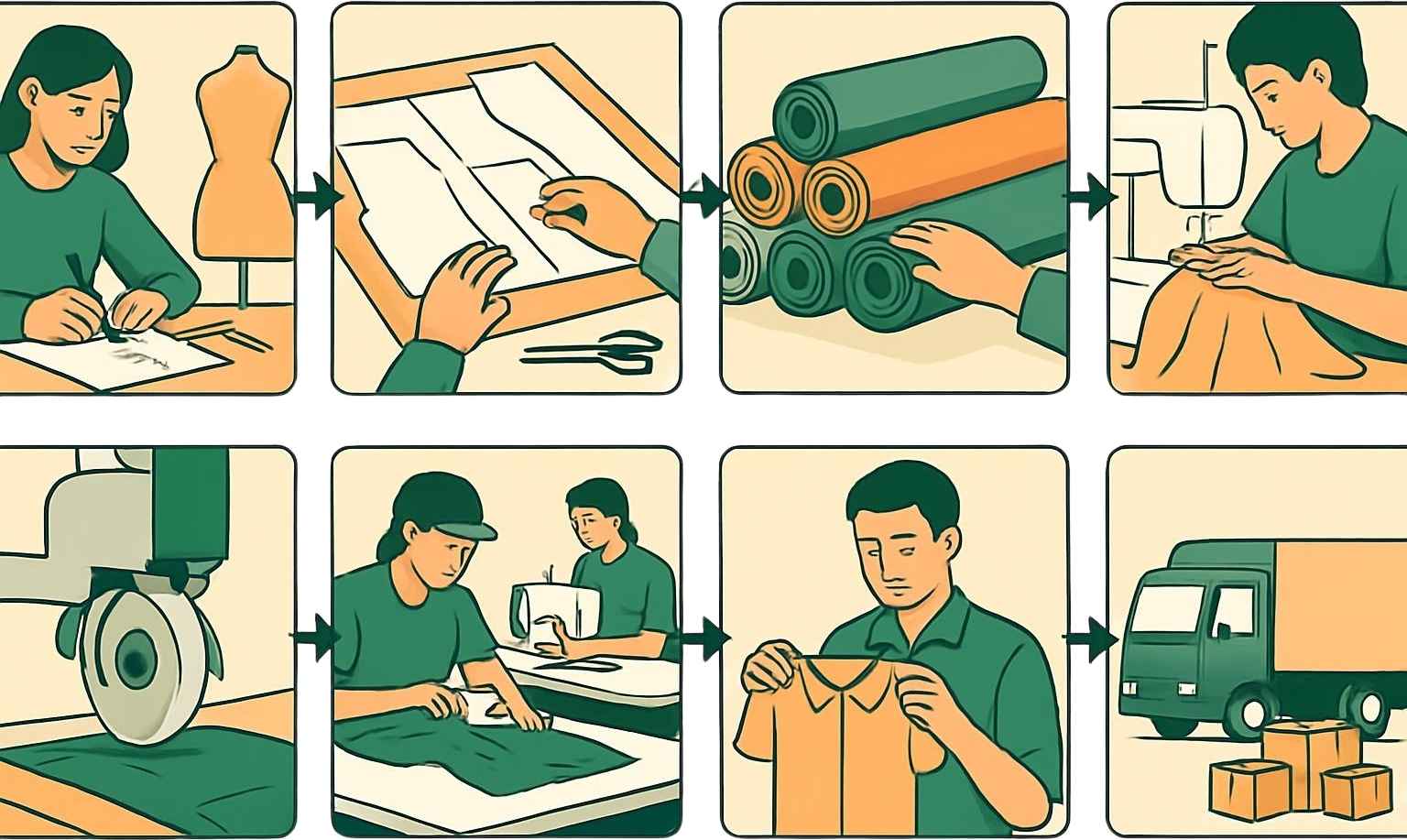
The clothing manufacturing process involves several stages, starting with an initial design idea and ending with finished garments ready for sale. It includes key steps such as design and pattern making, sourcing fabrics, cutting materials, sewing, quality control, and final distribution.
In the United States, this process may take place in domestic factories or through global supply chains. From concept to store shelves, it typically takes about 3 to 6 months.
Why Understanding the Clothing Manufacturing Process Matters
Have you ever wondered what happens between a designer sketching an idea on a napkin in a New York coffee shop and that same design appearing on a rack at your local mall in Chicago, Houston, or Los Angeles? The journey is much longer—and more complex—than most people think.
Whether you are a startup fashion brand in California, a retailer in London looking to launch a private-label line, a procurement manager in Germany, or simply someone curious about where clothes come from, understanding the clothing manufacturing process gives you a real advantage. It helps you make smarter sourcing decisions, avoid costly mistakes, manage timelines effectively, and build stronger relationships with manufacturers.
At Minmax Textile, we have worked with hundreds of brands across the USA, UK, Canada, France, and Germany. Through this experience, we have seen what separates brands that scale successfully from those that struggle with production delays and quality issues. This guide brings together everything we wish we had known from the start.
Let us walk through the full clothing manufacturing process, step by step.
Step 1: Concept Development and Fashion Design
Every garment starts as an idea. The design phase is where creativity meets strategy. Designers research trends, study what is selling in their target market, and identify the gap their collection will fill. For brands in the USA, this often means tracking what is popular on runways in New York and Paris while also keeping an eye on what is moving at Target or Nordstrom.
Key activities in the design phase include:
⦁ Trend research and mood board creation
⦁ Sketching original garment designs (hand-drawn or using CAD software like Adobe Illustrator or CLO 3D)
⦁ Deciding on silhouette, color palette, fabric type, and target customer
⦁ Creating a tech pack, which is a detailed document that manufacturers use to produce the garment correctly
A well-prepared tech pack is essential. It prevents miscommunication with overseas factories and is one of the single biggest factors that separates smooth production runs from expensive do-overs.
Step 2: Pattern Making and Grading
Once the design is approved, a pattern maker translates the sketch into precise flat pattern pieces that will eventually be cut from fabric. Pattern making is both a technical skill and an art form. Even the best design can fail at the consumer level if the pattern is off.
Pattern grading comes next. This is the process of scaling the base pattern up and down to a range of sizes, say, from XS to 3XL, in the US market. American sizing standards differ from European or UK conventions, so brands selling internationally need graded patterns for each market.
Modern pattern-making tools include:
⦁ Gerber Technology and Lectra (widely used in the USA and European factories)
⦁ CLO 3D for virtual fit simulation before physical samples are made
⦁ Traditional hand-drafted patterns for bespoke or artisan production
Virtual pattern software is increasingly popular because it lets brands like yours see how a garment drapes and moves before spending money on physical fabric and labor. Brands near manufacturing hubs in Los Angeles or in cities like Toronto and Manchester are increasingly adopting these tools to cut sample costs.
Step 3: Fabric Sourcing and Material Selection
Fabric is the backbone of any garment. Getting this step right determines the final feel, durability, and cost of your product. Sourcing is also where brands often encounter the most surprises if they are not prepared.
Fabric sourcing involves selecting material type (cotton, polyester, linen, bamboo, blends), deciding on weight and construction (woven versus knit), negotiating with mills or fabric suppliers, and ordering the right quantity. Minimum order quantities (MOQs) can be a real challenge for small brands. A fabric mill in China might have a MOQ of 500 meters, while a domestic mill in North Carolina or South Carolina might offer smaller runs at a premium.
Sustainable Fabric Sourcing: A Growing Priority
Sustainability is no longer optional, especially for brands selling to environmentally conscious consumers in the USA, UK, Germany, and France. According to a 2024 McKinsey report, over 60 percent of US consumers say they consider sustainability when making fashion purchases. Buyers increasingly expect certifications like GOTS (Global Organic Textile Standard) and OEKO-TEX.
Common sustainable fabric options:
⦁ Organic cotton (GOTS certified)
⦁ Recycled polyester (rPET from plastic bottles)
⦁ Tencel and Lyocell (wood pulp-based, biodegradable)
⦁ Hemp and linen (low water, low pesticide crops)
Step 4: Sampling and Prototype Development
Before any production run begins, samples are made. This is a non-negotiable part of the clothing manufacturing process. Samples protect you from committing budget to a product that does not meet your standards.
The typical sampling stages are:
⦁ Proto Sample: First rough version made in any available fabric to check construction and shape
⦁ Fit Sample: Made in the correct fabric, tested on live models or dress forms to check fit and comfort
⦁ Pre-Production Sample (PP Sample): The final approved version is used as the gold standard for the production run
⦁ TOP Sample (Top of Production): The first garment off the production line, confirmed before bulk production continues
Each round of sampling can take 2 to 4 weeks if working with an overseas factory, or as little as a few days with a domestic manufacturer near you in the USA. Budget for at least two to three rounds of sampling. Experienced brands build this into their production calendar from the start.
Step 5: Bulk Fabric Cutting
Once the pre-production sample is approved, the factory proceeds to bulk cutting. This step involves laying fabric in multiple layers (called a lay) and cutting through all layers at once using the approved patterns. Precision here is critical because even a small error multiplied across hundreds or thousands of garments can mean significant waste and rework costs.
Modern cutting methods include:
⦁ Manual cutting (standard for small runs or complex designs)
⦁ Automated CNC cutting machines (used in large facilities in the USA, Germany, and France for precision and speed)
⦁ Laser cutting (ideal for delicate fabrics and intricate details)
Fabric utilization rates matter enormously here. Good factories aim for fabric efficiency of 85 percent or higher. Lost fabric is lost money, and in today’s market, it is also a sustainability liability.
Step 6: Sewing and Assembly
Sewing is where your garment comes to life. Cut fabric panels are assembled by skilled workers using industrial sewing machines, sergers, and specialized equipment such as buttonhole and coverstitch machines. Most mid-to-large factories operate on a bundle system or a modular assembly line, where each operator specializes in one operation.
The speed and quality of sewing depend on the operator’s skill, factory management, and the garment’s complexity. A simple T-shirt might take under 10 minutes to sew, start to finish. A structured blazer could take 45 minutes or more.
Domestic vs. Offshore Manufacturing in the USA
One of the biggest decisions brands face is whether to manufacture domestically or overseas. Made-in-USA garments command a premium and have strong marketing appeal, particularly after the supply chain disruptions of 2020 through 2023, which prompted many brands to reconsider their reliance on offshore production.
US garment manufacturing hubs worth knowing:
⦁ Los Angeles, California: The largest garment manufacturing hub in the USA, home to thousands of sewing factories in the LA Fashion District
⦁ New York City, New York: Strong for small-batch, luxury, and fashion-forward production
⦁ Vernon and Commerce, California: Industrial garment manufacturing suburbs of LA
⦁ North Carolina and South Carolina: Historical textile hubs with strong fabric production infrastructure
For brands in Canada working with Minmax Textile near you, Toronto-area factories and Montreal’s storied garment district offer viable alternatives to offshore production with shorter lead times and simpler logistics.
Step 7: Washing, Finishing, and Embellishment
After sewing, garments undergo various finishing processes, depending on the design. These might include industrial washing (stone wash, acid wash, enzyme wash for denim), garment dyeing, heat transfer or screen printing, embroidery, adding buttons, zippers, or snaps, and ironing and pressing.
Embellishment quality is often where fast fashion and premium garments diverge most obviously. A hand-embroidered detail on a $200 blouse from a boutique in Nashville is a very different product from a printed graphic on a $15 T-shirt, even if the basic sewing process was similar.
Step 8: Quality Control and Inspection
Quality control (QC) is the safety net of the entire clothing manufacturing process. It happens at multiple points, not just at the end. World-class factories run inline QC at each sewing station and conduct final random inspections before shipment.
Quality inspection standards commonly used:
⦁ AQL (Acceptable Quality Level): The industry-standard sampling method. AQL 2.5 is common for general apparel; AQL 1.0 for higher-end or safety-critical garments
⦁ ASTM International Standards: Widely referenced in the USA for performance and safety testing
⦁ ISO 9001: Quality management system certification, common among factories supplying European brands in the UK, France, and Germany
If you cannot visit the factory yourself, hire a third-party inspection company. Services like Bureau Veritas, SGS, and QIMA operate globally and provide pre-shipment inspection reports that give you confidence before cargo leaves the factory.
Step 9: Labeling, Packing, and Compliance
Before garments can be legally sold in the USA or exported to markets in the UK, Canada, France, or Germany, they must meet labeling requirements specific to each jurisdiction.
USA labeling requirements (FTC Textile Rules) include:
⦁ Fiber content (percentage by weight)
⦁ Country of origin (e.g., Made in USA, Made in Bangladesh)
⦁ Care instructions (wash symbols per ASTM D5489)
⦁ Manufacturer or dealer identity (RN number or company name)
After labeling, garments are folded, tagged with hang tags and barcodes, and packed into polybags and cartons for shipping. Carton markings must match the packing list and commercial invoice exactly, or you risk delays at US Customs and Border Protection.
For brands concerned about intellectual property, this is also when you add brand-specific security tags, hologram stickers, or custom packaging that makes counterfeiting harder.
Step 10: Shipping, Logistics, and Delivery
The final leg of the clothing manufacturing process is getting finished goods to their destination. For most brands in the USA that import from Asia, this means ocean freight from ports like Shanghai, Guangzhou, or Dhaka to major US ports, including Los Angeles, Long Beach, New York, or Savannah.
Shipping options compared:
⦁ Ocean Freight (FCL or LCL): Most cost-effective for bulk orders. Lead time: 20 to 45 days from Asia to the USA
⦁ Air Freight: Fast but expensive, typically 3-7 days. Used for rush orders or high-value goods
⦁ Rail (Europe): Increasingly used for shipments from China to Germany or France via the Belt and Road rail network
Work with a licensed customs broker familiar with HTS (Harmonized Tariff Schedule) codes for apparel to avoid unexpected import duties. Apparel tariffs in the USA range from about 5 percent to 32 percent, depending on the fabric type and country of origin, so this step has a real financial impact.
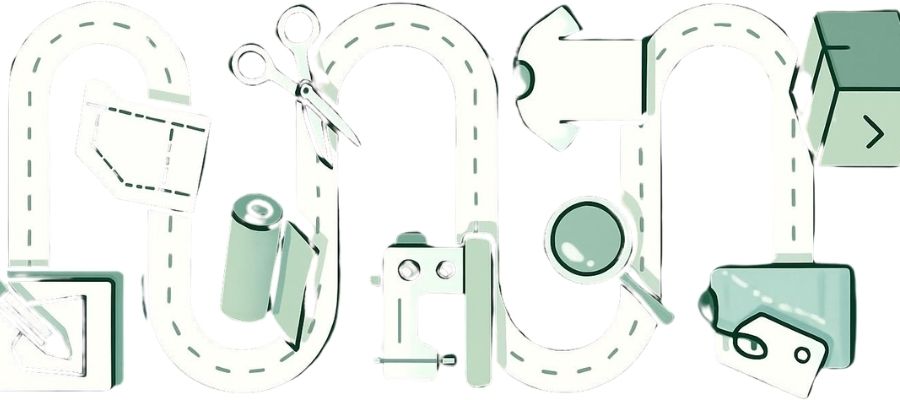
Clothing Manufacturing Near You in the USA: Local Insights
If you are searching for clothing manufacturing near you in the USA, your best bet depends on your location and production needs. Here is a quick regional snapshot:
⦁ West Coast (California): LA is the epicenter of US garment production. Hundreds of cut-and-sew factories serve everything from streetwear startups to major retailers. Labor costs are higher, but lead times are dramatically shorter than overseas.
⦁ East Coast (New York): NYC factories specialize in small-batch luxury and couture work. Ideal for brands needing close collaboration and rapid iteration.
⦁ Southeast (Georgia, North Carolina): Strong for textile production and knitwear. The Port of Savannah is the second busiest container port on the US East Coast, making it a logistics hub.
⦁ Midwest (Texas, Illinois): Emerging manufacturing scenes with lower operating costs. Dallas and Chicago have growing fashion communities supported by regional production capacity.
Minmax Textile partners with manufacturers across all these regions and internationally, helping brands find the right production home for their specific product, volume, and budget requirements.
Typical Clothing Manufacturing Timeline (Design to Delivery)
Understanding how long each step takes helps you plan your launch calendar realistically. The following is a general guide for a brand working with an overseas factory and targeting the USA market:
⦁ Design and Tech Pack Development: 2 to 4 weeks
⦁ Pattern Making and First Sample: 2 to 4 weeks
⦁ Sample Revisions (1 to 2 rounds): 2 to 6 weeks
⦁ Fabric Sourcing and Raw Material Lead Time: 4 to 8 weeks
⦁ Pre-Production Sample Approval: 1 to 2 weeks
⦁ Bulk Production: 4 to 8 weeks
⦁ QC Inspection: 3 to 5 days
⦁ Export Packing and Shipping: 1 to 2 weeks
⦁ Ocean Freight (Asia to USA): 3 to 5 weeks
⦁ Customs Clearance and Domestic Delivery: 3 to 7 days
⦁ TOTAL (approximate): 4 to 6 months
Best Practices for a Successful Clothing Manufacturing Process
1. Invest heavily in your tech pack. Factories can only make what you specify. Vague specs produce inconsistent results.
2. Visit your factory at least once. Nothing builds a production relationship like being present. If you cannot travel, hire a local agent.
3. Negotiate payment terms carefully. Standard terms are 30 percent deposit and 70 percent before shipment. Never pay 100 percent upfront.
4. Build buffer time into every deadline. Something will always take longer than planned. Build at least a two-week buffer into each milestone.
5. Conduct independent QC inspections. Do not rely solely on the factory’s self-reported quality checks.
6. Understand your import duties early. Calculate your landed cost before you commit to a manufacturer or target retail price.
7. Build real relationships with your manufacturer. Factories prioritize clients who communicate professionally, pay on time, and treat them as partners.
Frequently Asked Questions (FAQ)
What are the main steps in the clothing manufacturing process?
The process typically includes: design and concept development, pattern making and grading, fabric sourcing, sample development, bulk cutting, sewing and assembly, washing and finishing, quality control, labeling and packing, and finally shipping and delivery.
Each stage builds on the previous one, so skipping or rushing any step can lead to costly issues later.
How long does the clothing manufacturing process take?
For brands working with overseas factories and shipping to the USA, the process usually takes around 4 to 6 months from design approval to final delivery at the warehouse.
Domestic manufacturing in the USA can shorten this timeline to 8 to 12 weeks, though it often entails higher unit production costs.
What is a tech pack, and why is it important?
A tech pack (technical package) is a detailed document that communicates your product requirements to the manufacturer. It includes design sketches, measurements, fabric details, trims, construction instructions, and quality standards.
Without a clear tech pack, manufacturers are forced to guess your requirements—often leading to inaccurate samples and production errors.
How do I find clothing manufacturers near me in the USA?
You can start by exploring trade directories such as Makers Row, Sewport, or the California Fashion Association directory.
Attending trade shows like MAGIC (Las Vegas) or Texworld USA (New York) is also a great way to connect with manufacturers.
Alternatively, you can work with sourcing agents or partner with companies like Minmax Textile, which have established networks of trusted manufacturers both domestically and internationally.
What is the minimum order quantity (MOQ) for clothing manufacturing?
Minimum order quantities (MOQs) vary by manufacturer.
- Overseas factories often require 300–500 units per style.
- Some CMT (cut, make, trim) factories in China may accept as few as 100 units for simple items.
- US-based manufacturers typically offer lower MOQs, sometimes 50–100 units per style, making them ideal for testing new products before scaling.
Conclusion: Build Smarter with the Right Manufacturing Partner
The clothing manufacturing process is genuinely complex, but it is also navigable when you understand the terrain. Every successful apparel brand, from a one-person startup in Austin, Texas, to a global fast fashion giant, follows the same fundamental steps. What separates the brands that scale from those that stall is preparation, relationships, and attention to detail at every stage.
Whether you are launching your first collection, scaling an existing line, or reshoring your production to reduce supply chain risk, getting your manufacturing process right from the beginning saves you enormous time and money.
Ready to Start Your Clothing Manufacturing Journey?
Minmax Textile works with brands across the USA, UK, Canada, France, and Germany to bring apparel concepts to life, from tech pack development through final delivery. Our team has decades of combined experience in every step of the clothing manufacturing process.
Contact Minmax Textile today for a free consultation. Let us help you build something great.


