
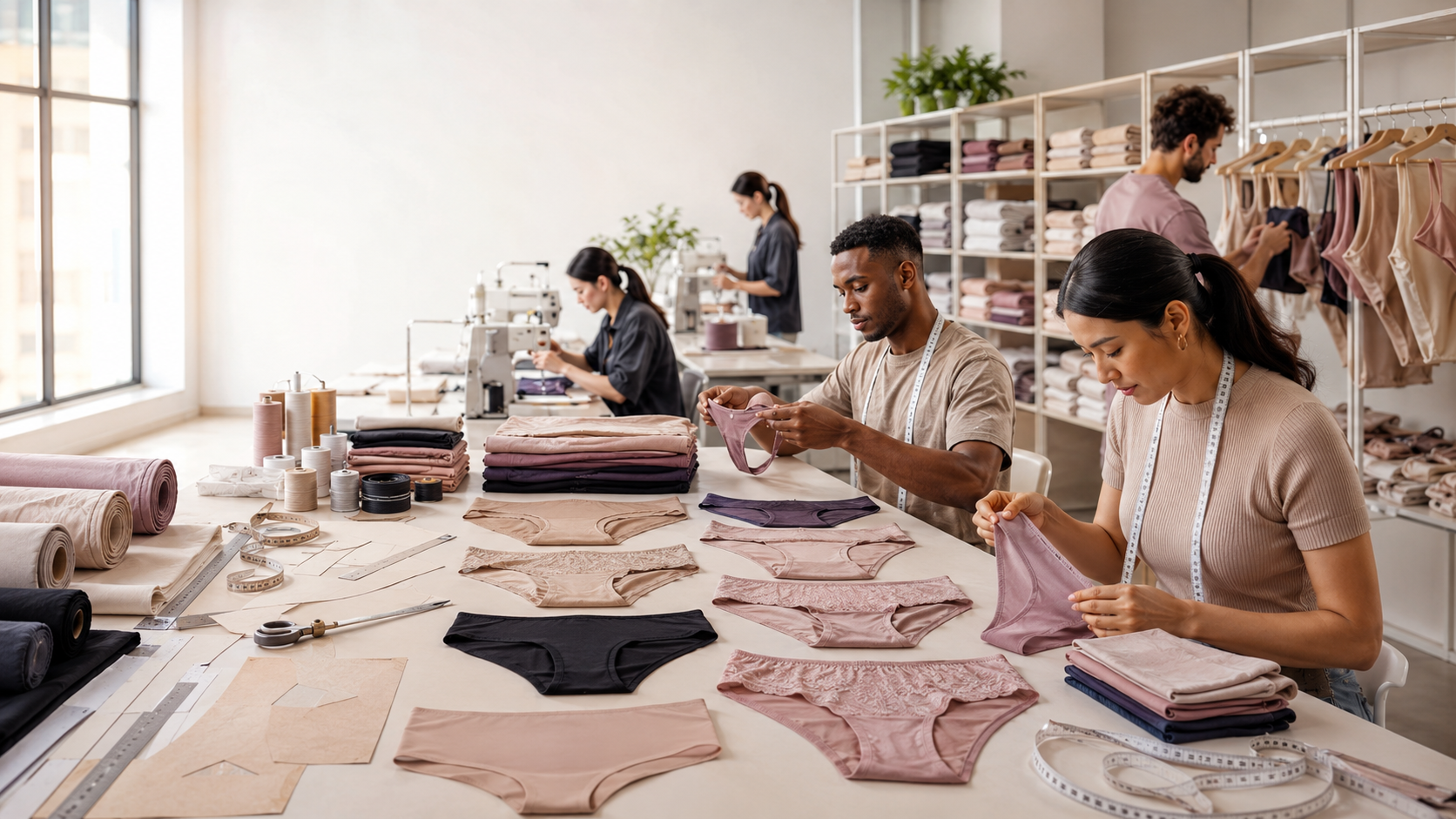
A women’s panties manufacturer designs, produces, and finishes women’s underwear in bulk for brands, retailers, and private-label businesses. This includes fabric selection, pattern cutting, stitching, quality control, branding, and packaging, delivered as private-label, OEM, or wholesale orders ready for retail or e-commerce.
Why Sourcing the Right Underwear Manufacturer Matters
Finding a dependable women’s underwear manufacturer is one of the hardest parts of building an intimate apparel brand. Fit problems, weak elastic, inconsistent sizing, and slow production timelines can quietly damage a brand’s reputation, even when the marketing and packaging look great.
Buyers across the United States, Canada, the United Kingdom, Australia, Germany, the Netherlands, the UAE, Saudi Arabia, Qatar, and South Africa all face similar sourcing questions: Which fabrics work best? How many pieces are needed for a minimum order? How is quality checked before mass production begins?
This guide walks through what a panties manufacturer actually does, the styles and fabrics available, how pricing and minimum order quantities typically work, and what to ask before placing a bulk order. It is written for fashion startups, established underwear labels, department stores, subscription-box companies, and wholesale buyers who want a clear, practical understanding of the sourcing process.
What a Women’s Panties Manufacturer Actually Does
A panties manufacturer handles the full production cycle of women’s underwear, from raw fabric to finished, packaged product. Typical responsibilities include:
- Sourcing and testing fabrics for stretch, breathability, and durability
- Pattern making and grading across a size range
- Cutting, sewing, and finishing garments
- Attaching elastic waistbands, gussets, and trims
- Applying labels, tags, and brand packaging
- Running quality checks before and after bulk production
- Packing and preparing shipments for domestic or international delivery
Some manufacturers only offer standard styles from an existing catalog. Others support fully custom development, starting from a sketch or reference sample. Knowing which type of manufacturer you need is the first step in sourcing successfully.
Private-Label, OEM, Wholesale, and Custom Underwear Production
Buyers often use these terms interchangeably, but they describe different production models.
Private-Label Panties
Private-label panties are produced using the manufacturer’s existing patterns and designs, then finished with the buyer’s own labels, tags, and packaging. This is a fast, lower-cost way for a brand to launch without developing patterns from scratch.
OEM Panties Manufacturer
An OEM panties manufacturer builds products based on a buyer’s original design, specifications, or sample. This route suits brands with a specific fit, fabric, or construction detail they want to protect and control.
Custom Panties Manufacturer
A custom panties manufacturer typically combines both approaches, adjusting existing patterns or developing new ones to match a brand’s exact requirements for fit, fabric, trims, and finishing.
Wholesale and Bulk Panties Supplier
A wholesale or bulk panties supplier sells ready-made styles in bulk quantities, usually with limited customization. This model works well for retailers and distributors who need stock quickly without a full development cycle.
| Production Type | Customization Level | Typical Speed | Best For |
|---|---|---|---|
| Private Label | Low to medium | Fast | New brands, startups |
| OEM | High | Slower | Established brands with unique designs |
| Custom | Medium to high | Medium | Brands needing specific fit or fabric |
| Wholesale/Bulk | Minimal | Fastest | Retailers, distributors |
Popular Women’s Panties Styles Manufacturers Produce
A capable ladies’ panties manufacturer should offer a wide range of styles, since demand varies by market, body type, and use case.
- Briefs – full coverage, everyday comfort
- Bikini panties – moderate coverage, mid-rise fit
- Boyshorts – shorter-leg coverage, popular for active wear
- Thongs – minimal coverage, low visibility under clothing
- Hipsters – lower-rise, relaxed fit
- High-waist panties – tummy coverage, popular for shapewear-style comfort
- Seamless panties – smooth finish with no visible lines under clothing
- Plus-size panties – wider size range with adjusted proportions for fit and comfort
A plus-size panties manufacturer should grade patterns properly across sizes rather than simply scaling a single base pattern, since fit, stretch distribution, and comfort change significantly at larger sizes.
Fabric Choices for Women’s Underwear
Fabric selection affects comfort, breathability, durability, and cost. Common options include:
- Cotton – breathable, soft, widely preferred for everyday basics
- Modal – smooth texture, good moisture handling, gentle on skin
- Microfiber – lightweight, smooth under clothing, quick-drying
- Lace – decorative, often combined with a cotton or mesh lining
- Mesh – breathable, often used in seamless or sport-style designs
- Nylon and stretch blends – added elasticity and shape retention
A cotton panties manufacturer typically focuses on everyday comfort and breathability, while a lace panties manufacturer or seamless panties manufacturer may focus more on finish, stretch recovery, and appearance under clothing. Many brands combine fabrics, such as a cotton gusset with a lace or mesh outer layer, to balance comfort with style.
Fit, Comfort, and Construction Details That Matter
Small construction choices affect how a garment performs over time and across repeated washing.
Waistbands and Elastic
Waistband elastic should sit flat without rolling or digging in. Covered elastic and picot-edge elastic are common finishing options depending on the style.
Gussets
The gusset is the inner fabric layer, usually cotton, that sits closest to the body. Proper gusset construction supports hygiene and everyday comfort.
Seams and Stitching
Flat-lock or seamless construction reduces visible lines and irritation. Reinforced stitching at stress points, such as the crotch seam and waistband, improves durability.
Sizing Consistency
Consistent sizing across a full range, from small through plus sizes, is one of the most common quality issues buyers report. Requesting a size grading chart and pre-production sample set helps confirm consistency before bulk production begins.
Custom Branding, Colors, and Packaging
Beyond the garment itself, manufacturers typically support:
- Custom colorways and print patterns
- Woven or printed brand labels
- Care and size tags
- Hang tags and branded packaging
- Poly bags, boxes, or eco-friendly packaging options
For markets such as the UAE, Saudi Arabia, and Qatar, premium and discreet packaging is often a priority for retail and gifting purposes. For Germany and the Netherlands, buyers frequently ask about recyclable or minimal packaging materials as part of a broader sustainability approach.
Minimum Order Quantities, Samples, and Pricing
Minimum order quantities (MOQs), sample policies, and pricing structures vary by manufacturer and production type.
- MOQs are usually set per style and per color, and may be lower for private-label production than for fully custom OEM development.
- Samples are typically produced before bulk production to confirm fit, fabric, and construction.
- Pricing depends on fabric type, style complexity, trims, order volume, and packaging requirements.
- Production time generally increases with customization level and order size.
Buyers should always request a written quote that separates sample costs, bulk unit pricing, and shipping costs, since bundled pricing can make comparisons between suppliers difficult.
Quality Control Before Bulk Production
A reliable custom underwear supplier should perform quality checks at multiple stages rather than only at the end of production.
- Fabric inspection for weight, stretch, and defects
- Pre-production sample review for fit and construction
- In-line inspection during bulk sewing
- Final inspection before packing and shipping
Buyers should ask whether inspections are done in-house, by a third party, or both, and whether inspection reports or photos are shared before shipment.
How to Choose a Reliable Women’s Panties Manufacturer
Choosing the right manufacturing partner is easier with a clear evaluation process.
Questions to Ask Before Ordering
- What is the minimum order quantity per style and color?
- Can you provide a physical sample before bulk production?
- What fabrics and trims are available, and can I request specific ones?
- What is your standard production timeline after sample approval?
- How is quality checked before shipping?
- What packaging and labeling options are available?
- What shipping methods and destinations do you support?
Common Sourcing Mistakes to Avoid
- Skipping a physical sample and approving only digital mockups
- Not confirming size grading across the full range
- Focusing only on unit price without checking construction quality
- Failing to clarify packaging and labeling requirements early
- Not confirming shipping timelines against launch or restock dates
A Simple Step-by-Step Ordering Process
- Define requirements – styles, fabrics, sizes, and target price point
- Request quotes and samples from shortlisted manufacturers
- Review samples for fit, fabric feel, and construction
- Confirm specifications including labeling, packaging, and colorways
- Approve pre-production sample before bulk cutting begins
- Monitor production through inspection updates or reports
- Review final inspection results before shipment
- Arrange shipping and confirm delivery documentation
Local Market Considerations for Buyers
Sourcing needs shift depending on target market and climate.
- USA and Canada – Strong demand for inclusive sizing, soft cotton basics, and private-label programs for direct-to-consumer brands.
- UK – Buyers often prioritize consistent fit, clear product labeling, and supplier transparency around sourcing practices.
- Australia – Lightweight, breathable fabrics are popular for everyday comfort in warmer climates.
- Germany and the Netherlands – Buyers frequently ask about material traceability, responsible sourcing, and durable construction that holds up over repeated washing.
- UAE, Saudi Arabia, and Qatar – Breathable fabrics, premium packaging, and modest retail presentation are common priorities, particularly for department store and boutique placement.
- South Africa – Affordability combined with durability and a wide fit range supports both retail and wholesale distribution channels.
These are general patterns rather than fixed rules, and manufacturers should be able to adjust fabric, fit, and packaging based on each buyer’s specific market and customer base.
Building Trust and Local Visibility as a Manufacturer
For manufacturers looking to build credibility with international buyers, a few practical steps help:
- Maintaining an updated Google Business Profile with accurate contact details
- Listing on relevant industry and B2B directories
- Sharing genuine customer and buyer reviews
- Publishing location-specific service pages for key export markets
- Using real factory and product photos instead of stock imagery
- Providing clear shipping timelines and contact information
- Offering physical samples and quality documentation on request
- Being transparent about production processes and capabilities
Buyers rely heavily on reviews and clear business information because underwear sourcing involves both product quality and trust. A manufacturer that documents its process and responds clearly to questions is easier to evaluate than one that only offers general claims.
Companies such as Minmax Textile work with brands and retailers on private-label, OEM, wholesale, and custom women’s panties production, offering one example of how a manufacturing partner can support different order types and market requirements. Buyers should still compare multiple suppliers and request samples before committing to a manufacturing partner.
Frequently Asked Questions
What does a women’s panties manufacturer do? A women’s panties manufacturer produces underwear in bulk, handling fabric sourcing, pattern making, sewing, quality checks, branding, and packaging for private-label, OEM, or wholesale orders.
What is the difference between private-label and OEM panties? Private-label panties use the manufacturer’s existing patterns with the buyer’s branding, while OEM panties are built from the buyer’s own design or specifications.
What is the usual minimum order quantity for women’s underwear? Minimum order quantities vary by manufacturer, style, and production type, and are usually set per style and per color. Buyers should confirm MOQs directly with each supplier.
How can buyers check fit and quality before bulk production? Requesting a pre-production sample and reviewing fabric, stitching, elastic, and sizing before approving bulk production is the most reliable way to confirm quality.
Which fabrics are best for women’s panties? Cotton is common for everyday comfort and breathability, while modal, microfiber, lace, and mesh are chosen for softness, moisture handling, or visual finish depending on the style and intended use.
Getting Started With Your Underwear Sourcing Plan
Sourcing women’s panties successfully comes down to a few clear steps: define your product requirements, request and review physical samples, confirm sizing across your full range, and compare suppliers on quality and communication rather than price alone.
Whether you are launching a new intimate apparel brand, expanding a private-label program, or sourcing wholesale stock for retail, taking time to evaluate manufacturers properly reduces costly fit and quality issues later. Reach out to Minmax Textile or another qualified women’s panties manufacturer to request samples, discuss your specifications, and compare options before placing a bulk order.


