
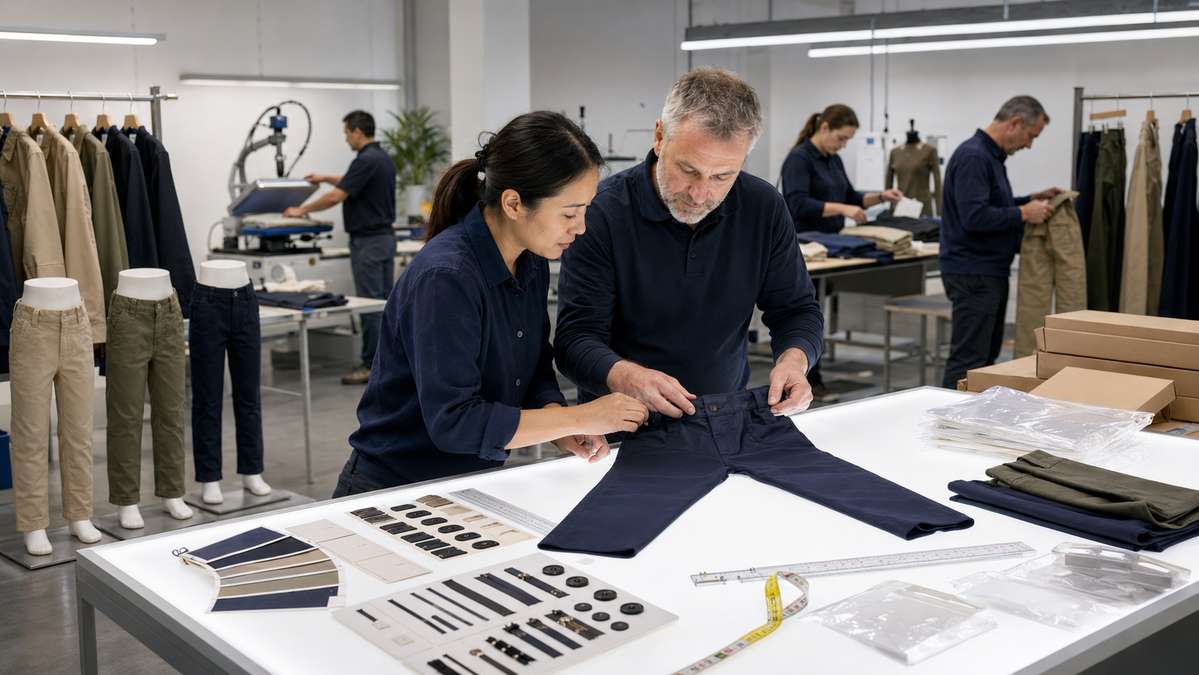
A kids’ twill pants manufacturer makes custom trousers, chinos, school pants and casual bottoms for brands, retailers and uniform suppliers. A reliable factory should control fabric weight, fit, waist construction, stitching, color, trims, labels and final inspection. Buyers should approve samples and written standards before any bulk production begins.
Why a simple pair of pants can become a difficult order
Kids’ twill pants need to look neat, feel comfortable and survive active use. That sounds simple. In practice, many small details can cause a problem. A waistband may feel tight when a child sits. A dark color may fade too fast. Knees may wear out early. Sizes may grade poorly from toddlers to older children.
These issues can lead to returns, poor reviews, and slow repeat sales. They can also harm a school uniform program.
The right kids’ twill pants manufacturer does more than cut and sew fabric. It helps the buyer select a sensible material, build a clear size chart, test the garment, and keep bulk production close to the approved sample.
Minmax Textile presents its range of kids’ twill pants for school uniforms, everyday wear, and smarter outfits. The listed options include straight, slim, and skinny styles, as well as custom colors and branding. This guide explains how buyers can develop those products with less risk.
First decision: define the job of the garment
Before discussing price, decide what the pants must do. A school trouser, a fashion chino and an outdoor play pant do not need the same fabric or fit.
Ask these questions first:
- Who will wear the pants, and what is the age range?
- Will they be used for school, casual retail, events or uniforms?
- Should the fit be straight, slim, skinny, relaxed or pull-on?
- Will the child wear them in hot, mild or cold weather?
- How often should the garment be washed?
- Is the range seasonal or available all year?
- What retail price and product quality must the order support?
A clear use case helps a factory give useful advice. It also makes quotes easier to compare. Buyers building several product groups can consider Minmax Textile as a custom clothing manufacturing partner, rather than treating each garment as a separate sourcing project.
What is twill fabric?
Twill is a woven fabric with visible diagonal ribs. The weave can give it a firm structure and good resistance to daily wear. Cotton twill and cotton-blend twill are common choices for children’s pants, chinos, and school trousers.
However, the word “twill” is not a complete fabric specification. Two fabrics can share the same weave and still feel very different. Buyers need to define:
- fiber content;
- fabric weight or GSM;
- yarn quality;
- stretch percentage, if used;
- surface finish;
- color standard;
- shrinkage limit;
- colorfastness requirements; and
- special treatments, if any.
For example, a lightweight cotton twill may suit warmer regions. A heavier twill may give better structure for cold seasons. A small amount of stretch can improve movement, but poor recovery may leave the knees baggy. Always test the actual fabric rather than relying on a description alone.
A practical fabric decision table
| Fabric option | Main strength | Point to check |
|---|---|---|
| 100% cotton twill | Natural feel and breathable comfort | Shrinkage, creasing and shade change |
| Cotton-polyester twill | Easy care and added durability | Hand feel and heat comfort |
| Cotton-elastane twill | Better movement and closer fits | Stretch recovery and seam strength |
| Brushed twill | Softer, warmer surface | Pilling and finish consistency |
| Lightweight twill | Useful for warm climates | Opacity and wear resistance |
| Midweight or heavy twill | Firm shape and greater coverage | Bulk, stiffness and drying time |
Request a fabric cut before sample development. Wash it with the planned care method. The result may change the choice before sampling.
Fit is the feature customers notice first
Fabric quality cannot save a poor fit. Kids need room to sit, bend, run, and grow. At the same time, buyers want a clean shape that suits their market.
Straight fit
A straight leg is a useful choice for uniforms and broad retail ranges. It can be easy to grade and works across many age groups.
Slim fit
A slim shape gives a modern look without being extremely close to the body. It needs careful control at the hip, thigh, knee and hem.
Skinny or stretch fit
Skinny pants need enough stretch and recovery for comfort. The manufacturer should test seam strength and movement, especially at the seat and knee.
Relaxed or pull-on fit
An elastic waist and relaxed leg can help younger children dress without support. The elastic must remain comfortable and stable after repeated washing.
The manufacturer’s development team should explain what is possible within the target price. Minmax Textile’s company profile describes in-house sample development, garment technical support, quality assurance, and shipping teams. Buyers should still test each fit on the intended age group before approval.
Build the waistband around the child
The waistband often decides whether parents call a pair of pants comfortable. Common choices include a fixed waist, full elastic, back elastic, half elastic, or an internal button-adjuster system.
For school trousers and growing children, an adjustable waist can extend useful wear. But it must be designed with care. Check that:
- elastic does not twist inside the waistband;
- buttons and adjusters are secure;
- internal parts do not rub the skin;
- the waist stays flat when tightened;
- the fly and closure are easy to use; and
- the waistband returns to shape after washing.
Younger age groups may benefit from pull-on styles. Older children may expect a zip fly, button or hook-and-bar closure. The correct choice depends on age, use and local safety rules.
A tech pack removes expensive guesswork
A strong tech pack gives every team one approved source of information. It should include more than a fashion sketch.
Add the following details:
- Front and back technical drawings.
- Fabric composition, weight, stretch and color reference.
- Fit description and intended age group.
- Full measurement chart with tolerances.
- Waistband, fly, pocket and belt-loop construction.
- Stitch type, seam allowance and reinforcement points.
- Button, snap, zipper and elastic details.
- Logo artwork and placement.
- Main label, size label and care label text.
- Folding, packing, size ratio and carton marks.
- Required testing and inspection method.
Use clear images of the pocket shape, topstitching, and trim placement. If a design has contrast thread, define the thread color and stitch distance. Words such as “standard pocket” or “good zipper” are too open to interpretation.
Buyers can also browse the broader kids’ clothing manufacturing category to create a common size system across pants, polos, sweaters, and shorts.
Size grading should follow growth, not guesswork
Children’s body proportions change as they grow. A single-grade rule may not work across toddler-to-teen sizes.
Important measurements include:
- waist relaxed and extended;
- hip width;
- front and back rise;
- thigh width;
- knee width;
- inseam and outseam;
- leg opening;
- waistband height;
- pocket opening; and
- fly or closure length.
The smallest, middle and largest sizes should be reviewed. Measure each sample on the same flat surface and use one written method. Then check movement on a suitable fit model or form. The child should be able to sit, squat and climb stairs without strain.
Allow for the fabric’s behavior after washing. If the approved sample fits before washing but becomes short or tight later, the pattern or fabric finish needs correction.
Details that improve wear and reduce complaints
Small construction choices can make a basic pair of trousers feel much better.
Reinforced stress points
Seat seams, pocket corners, belt loops and fly areas often need extra strength. Bar tacks or other reinforcements should be neat and secure.
Useful pockets
Pocket bags should be deep enough for the intended age group and made from a fabric that will not tear easily. Check that pocket edges lie flat.
Smooth internal finishing
Rough seam ends, hard labels and sharp trim edges can cause discomfort. Inspect the inside of the garment as closely as the outside.
Reliable closures
Zippers should move smoothly and stay flat. Buttons, snaps and hooks must be suitable for the age group and pass the required attachment checks.
For warm-weather extensions, Minmax Textile’s kids’ shorts and short pants range can support a shared fabric or color story. Even when two styles use the same twill, confirm their own measurements, construction, and MOQ.
Private label and OEM choices
Private-label kids’ twill pants can be customized in fit, fabric, color, stitching, trims, and packaging. Common branding options include:
- woven or printed main labels;
- size and care labels;
- embroidery or small patches;
- branded buttons, snaps or zipper pullers;
- custom hangtags;
- barcode and price stickers;
- individual bags or paper bands; and
- custom carton marks.
Keep decoration practical. A large patch may feel stiff. Heavy embroidery can pull on light fabric. Metal trims may add cost, weight, and testing needs. Ask for a sample with the final branding before bulk approval.
An OEM kids’ clothing manufacturer should follow the buyer’s technical file. An ODM service may also help create or adapt the design. State which model you need, since development ownership and charges may differ.
Safety, testing and product records
Children’s apparel rules vary by age group and destination. The buyer and importer should confirm current legal duties with a qualified laboratory or compliance adviser. A supplier’s general claim of “international quality” is not enough.
The test plan may need to cover:
- fiber content and label accuracy;
- restricted substances;
- colorfastness to washing and rubbing;
- dimensional stability;
- seam strength and slippage;
- button, snap and trim attachment;
- sharp points or edges;
- small-parts risks for younger children; and
- flammability rules where they apply.
Keep lab reports, approved samples, purchase orders and inspection records together. Make sure tested materials match bulk materials. If the factory changes a fabric, dye, button or print supplier, it should request approval first.
Quality control from fabric roll to carton
Final inspection alone cannot fix every problem. Strong quality control starts before cutting.
Fabric inspection
Check width, weight, shade, surface faults and shrinkage. Separate shade groups so that no garment contains mismatched panels.
Cutting and sewing checks
Confirm pattern direction, measurements, pocket placement, seam shape and reinforcement. Early checks prevent the same fault from spreading through the full order.
Finishing checks
Review loose threads, stains, pressing, label position, zipper function and waistband recovery. Measure finished garments from each size and color.
Final random inspection
Use a written acceptance plan. Check quantity, appearance, measurements, workmanship, labels, packing and carton details. Minmax Textile states that its broader quality process includes internal audits, third-party testing, and a pre-final inspection at AQL 2.5. The exact plan for a twill-pants order should still be agreed in writing.
The company also supplies boys’ twill pants for wholesale programs, which may help buyers compare age- or gender-led ranges. Keep one controlled quality standard across related products whenever possible.
Local planning for ten target markets
Good localization changes the product plan. It does not simply place country names on a page.
| Market | Practical product and sourcing point |
|---|---|
| USA | School chinos and casual twill pants can serve different price levels. Confirm children’s testing, tracking, and labeling duties with the importer. |
| Australia | Plan around Southern Hemisphere seasons. Lighter cotton twill may suit warmer regions, while southern areas may need heavier options. |
| UK | Grey, navy, and black school trousers can support demand for uniforms. Easy care, adjustable waists, and repeat color are important. |
| UAE | Lightweight, breathable twill can work for school and indoor use. Avoid heavy fabric unless the buyer asks for it. |
| Germany | Clear specifications, durable construction, and product records help support buyer review. Confirm current EU safety, chemical, and labeling duties. |
| Canada | Allow room for cold-weather layers where needed. Confirm English, French, and provincial labeling needs with the importer. |
| Saudi Arabia | Light to midweight pants may suit schools and indoor settings. Ask the local buyer about Arabic labels and import documents. |
| Netherlands | Comfortable movement, simple care, and durable knees can support daily school and casual use. Midweight styles offer broad use. |
| South Africa | Climate and price needs vary by region. Consider separate weights or seasonal deliveries rather than a single national plan. |
| Qatar | Breathable school and smart-casual pants are suitable for air-conditioned settings. Confirm local labels, documents and delivery dates early. |
These points support planning, but they are not legal advice. Local buyers should approve the final size chart, labels, testing plan and product calendar.
MOQ, pricing and lead time without surprises
Twill-pants prices depend on more than order quantity. Fabric weight, fiber blend, dyeing method, wash treatment, size range, pocket count, trims, testing, and packaging all affect cost.
Send the same request to each shortlisted factory. Include:
- units per style and color;
- size ratio;
- fabric details;
- destination;
- target delivery date;
- branding and packing;
- testing needs; and
- preferred shipping term.
Ask the supplier to separate sample, testing, trim, packaging, and freight charges where possible. This helps you compare landed costs rather than a single unclear unit price.
Minmax Textile’s category page mentions flexible order quantities, while its company profile publishes a benchmark MOQ of 2,000 pieces per color and style. Its profile also provides longer-lead-time examples for imported fabric. These figures may not apply to every kids’ twill pants order. The signed quotation and purchase order should control the final MOQ, price, and schedule.
Brands creating a schoolwear set may pair trousers with custom kids’ polo shirts. Coordinated buying can improve color planning, but each category should have its own approved sample and quality rules.
Nine questions to ask a factory
Before placing a bulk order, ask:
- Which twill fabrics can you source at this price and for this market?
- Can you provide the exact fiber content, weight, and stretch?
- How do you control shrinkage and color variation?
- Can you develop an adjustable waist and our custom fit?
- What is the MOQ by style, fabric, and color?
- Which samples are needed, and how long does each stage take?
- Which tests can you arrange for the destination market?
- How will bulk goods be inspected before shipment?
- What happens if the order does not match the approved sample?
The quality of the answers matters. Clear, specific replies show more value than quick promises of the lowest price.
Trust signals buyers should check
Review the supplier’s business identity, address, product experience and communication before sending a deposit. Ask for current audit or certification records if your company requires them. Verify the issuing body, dates and scope rather than accepting a logo on a sales document.
Samples and test reports remain the strongest evidence of the product. Reviews can add useful context about communication and repeat quality. A consistent Google Business Profile and relevant local directory listings can also help confirm a factory’s identity and location. They should support due diligence, not replace it.
For larger orders, consider a factory visit or an independent audit. At minimum, arrange a video review of the sample, production area, and finished goods with the merchandising team.
Frequently asked questions
What can a kids’ twill pants manufacturer produce?
Common products include school trousers, chinos, straight pants, slim pants, skinny stretch pants, pull-on trousers and uniform bottoms. Available styles depend on fabric, machinery, pattern skills and order size.
Is cotton twill suitable for children’s pants?
Yes. Cotton twill can provide comfort, structure and daily durability. Buyers should still test shrinkage, colorfastness, seam strength and care performance. A cotton blend may be better when easy care or added strength is needed.
Can kids’ twill pants include adjustable waists?
Yes. Internal elastic and button adjusters are common in children’s school and casual pants. Check comfort, attachment strength, age suitability and waistband shape in the approved sample.
What is the MOQ for private label kids’ pants?
MOQ varies by fabric, dye color, trim, style and manufacturer. Ask for the minimum by style and color. Do not rely on a general website figure without a written quote for the exact product.
How can buyers reduce defects in bulk production?
Use a detailed tech pack, approve fabric and trims, test the pre-production sample, set measurement tolerances, and inspect during production. A final random inspection should compare the order with the approved standard before shipping.
Turn a good sample into a dependable repeat order
The best kids’ twill pants are not defined by one feature. They combine a suitable fabric, a comfortable fit, a secure waist, strong seams, stable color, and clear product records. Those details help a brand protect margins and give families a garment they can use often.
Minmax Textile offers custom and wholesale kids’ twill pants from Bangladesh for international buyers. To request a quote, send the style drawing, fabric target, quantity, colors, size ratio, destination, testing needs, and required date via the company’s contact page. A complete brief is the fastest route to an accurate sample, price, and production plan.


