
Finding the right clothing manufacturer is one of the most important decisions you will make as a fashion brand. A good manufacturer helps you turn a design idea into a product customers can trust. The wrong one can leave you with poor samples, missed deadlines, inconsistent sizing, wasted fabric, and money tied up in unusable inventory.
The challenge is not simply finding a factory. There are thousands of garment manufacturers around the world. The real challenge is finding one that matches your product type, order quantity, quality expectations, timeline, budget, and communication style.
This guide explains how to find a clothing manufacturer step by step, what to prepare before contacting factories, how to compare suppliers, and what warning signs to watch for before placing your first bulk order.
What Is a Clothing Manufacturer?
A clothing manufacturer is a company or factory that produces garments for fashion brands, retailers, ecommerce businesses, uniforms, promotional apparel companies, and private labels.
Depending on the manufacturer, they may handle only sewing or offer a complete production service that includes fabric sourcing, patternmaking, sample development, grading, printing, embroidery, washing, finishing, labeling, packaging, and bulk production.
Some manufacturers work with startup brands. Others only accept established companies with larger order volumes. Some specialize in basic t-shirts, hoodies, and activewear, while others focus on woven shirts, denim, outerwear, underwear, babywear, uniforms, or luxury garments.
Before you start searching, you need to understand which type of manufacturer fits your business.
Step 1: Know What Type of Clothing Manufacturer You Need
Not all manufacturers work the same way. Choosing the wrong type can slow down your project before it starts.
Private Label Clothing Manufacturer
A private label manufacturer produces ready-made or semi-custom garments that you can brand with your own label, logo, packaging, or design details.
This option is useful if you want to launch quickly without having to develop every garment from scratch. For example, a brand may choose an existing hoodie style, adjust the fabric weight, add custom labels, change the color, and apply screen printing or embroidery.
Private label manufacturing is usually faster and simpler than full custom production.
Cut and Sew Manufacturer
A cut-and-sew manufacturer makes garments from raw fabric based on your pattern, measurements, tech pack, and design specifications.
This is the right choice if you want custom fits, original silhouettes, unique construction details, or garments that cannot be made from stock blanks.
Cut-and-sew production gives you more control, but it also requires more preparation. You will usually need a tech pack, pattern, sample approval, fabric details, trims, and clear size grading.
OEM Clothing Manufacturer
OEM stands for Original Equipment Manufacturer. In apparel, this means the factory produces garments according to your design, tech pack, and specifications.
You own the design direction. The manufacturer follows your instructions.
OEM production is common for brands that already know what they want and need a factory to execute it accurately.
ODM Clothing Manufacturer
ODM stands for Original Design Manufacturer. An ODM factory can provide existing designs, patterns, or product concepts that you can modify and sell under your brand.
This is helpful if you need product development support or want to reduce design time. However, your product may not be as unique unless you customize it carefully.
Low MOQ Clothing Manufacturer
MOQ means Minimum Order Quantity. A low MOQ manufacturer accepts smaller production runs, which is helpful for startups, test launches, limited drops, and boutique brands.
The trade-off is that smaller orders often cost more per piece. Factories still need to spend time on sampling, setup, cutting, sewing, trims, and quality control, even for small orders.
Full-Service Clothing Manufacturer
A full-service manufacturer can support several stages of production, including product development, fabric sourcing, sampling, bulk production, quality control, labeling, and packaging.
For many brands, this is the easiest route because a single production partner manages the process rather than several disconnected suppliers.
Minmax Textile, for example, works best with brands that want structured manufacturing support rather than simply looking for a sewing line.
Step 2: Define Your Product Before You Contact Factories
Many brands start by asking, “How much does it cost to manufacture clothing?”
A better first question is, “What exactly am I asking the factory to make?”
A manufacturer cannot give an accurate quote without product details. If your request is vague, you will either get a rough estimate or no response at all.
Before contacting a clothing manufacturer, prepare the basics:
- Product type, such as t-shirt, hoodie, leggings, jacket, dress, polo shirt, or uniform
- Target fabric, such as cotton jersey, fleece, denim, polyester, nylon, rib, woven cotton, or blended fabric
- Approximate order quantity
- Size range
- Color options
- Logo or branding requirements
- Printing, embroidery, washing, dyeing, or finishing needs
- Label and packaging requirements
- Target market and expected quality level
- Desired launch date
You do not need to have everything perfect at the beginning. But the clearer you are, the easier it is for a manufacturer to understand your project and respond professionally.
Example: Weak Inquiry vs Strong Inquiry
A weak inquiry sounds like this:
“Hi, I want to start a clothing brand. Can you make clothes? What is your price?”
A strong inquiry sounds like this:
“Hi, I am looking for a manufacturer for a 350 GSM cotton fleece hoodie with custom embroidery, woven neck label, size range S–XXL, and an initial order of 300 pieces per color. I have reference photos and need help with sampling, fabric sourcing, and bulk production.”
The second message gives the manufacturer enough context to take the project seriously.
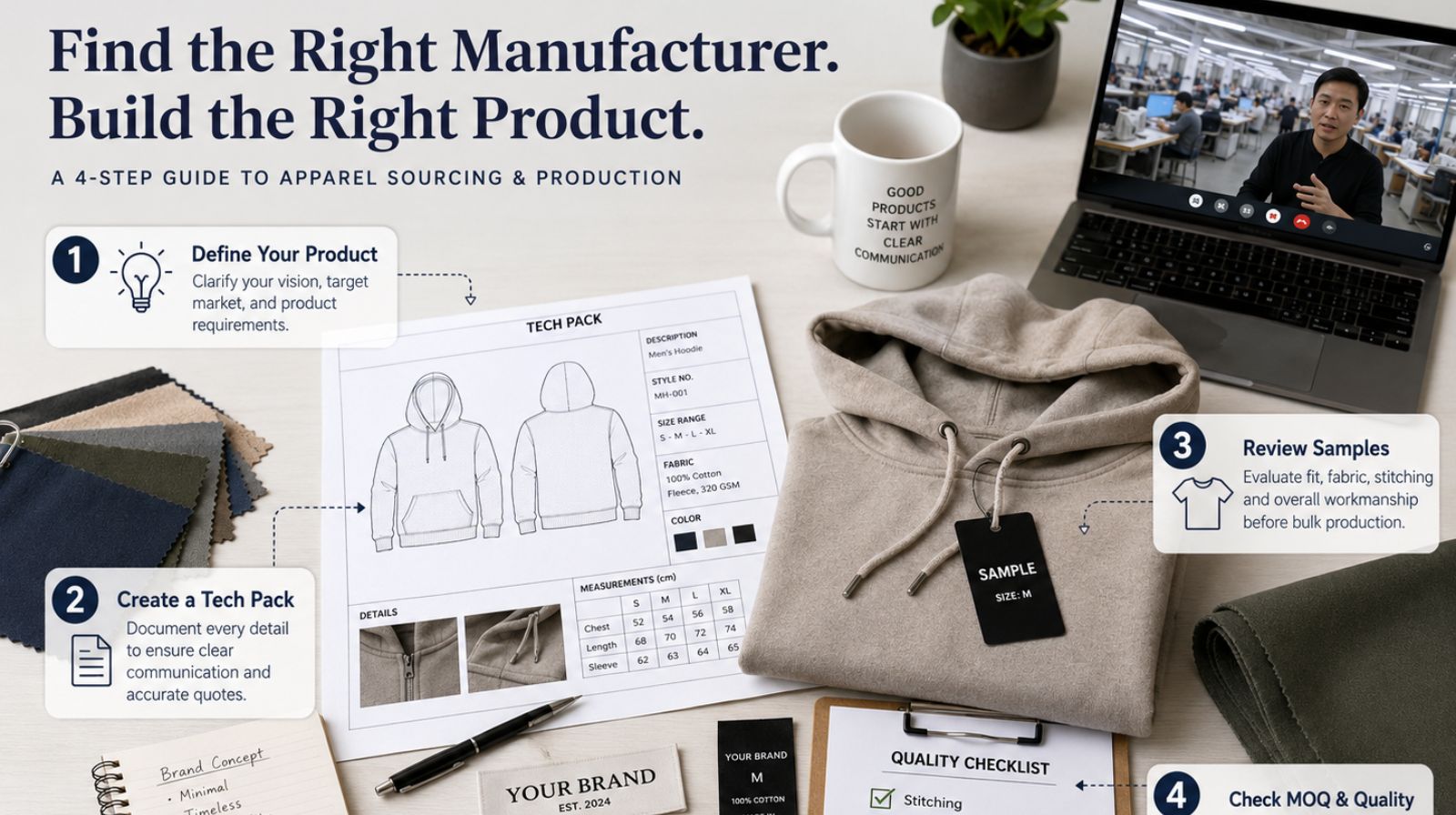
Step 3: Prepare a Tech Pack
A tech pack is the blueprint for your garment. It tells the manufacturer exactly how the product should be made.
A proper tech pack reduces confusion, sample errors, costing mistakes, and production delays. It also helps you compare quotes from different manufacturers more fairly because each factory is pricing the same product specifications.
A basic tech pack usually includes:
- Flat sketches or technical drawings
- Reference images
- Fabric composition and weight
- Measurements and size chart
- Stitching and construction details
- Colorways
- Trims, buttons, zippers, drawcords, labels, and tags
- Print or embroidery placement
- Packaging instructions
- Bill of materials
- Tolerance notes
- Quality expectations
If you do not have a tech pack, some manufacturers can help you develop one. However, you should expect additional time and cost for product development.
A practical tip: never rely only on inspirational photos. A photo shows the look, but it does not explain fabric weight, seams, measurements, shrinkage, trims, or construction.
Step 4: Decide Between Local and Overseas Clothing Manufacturers
Both local and overseas manufacturing can work well. The right choice depends on your budget, timeline, quantity, product complexity, and level of control.
Local Clothing Manufacturers
Local manufacturers are often easier to visit, communicate with, and monitor. Shipping can be faster, and there may be fewer import complications.
They can be a strong option for small runs, premium products, quick sampling, or brands that want “Made in USA,” “Made in UK,” “Made in Canada,” or similar origin claims.
The downside is usually higher labor costs and sometimes limited capacity for large-scale production.
Overseas Clothing Manufacturers
Overseas manufacturers are common for brands that need competitive pricing, larger production capacity, wider fabric options, and scalable manufacturing.
Countries such as Bangladesh, China, India, Vietnam, Turkey, Pakistan, Portugal, and Cambodia are known for apparel production, though each region has different strengths.
The main challenges are communication, time zones, shipping, customs, quality control, and supplier verification. These risks can be managed, but they should not be ignored.
Which One Should You Choose?
Choose local manufacturing if speed, small batches, hands-on control, or origin labeling matters most.
Choose overseas manufacturing if you need stronger cost efficiency, larger capacity, broader sourcing options, or long-term scalable production.
For many fashion brands, the best decision is not local versus overseas. It is whether the manufacturer has the right experience with your product category.
Step 5: Where to Find Clothing Manufacturers
Once you know your product type and production needs, you can start searching. Use more than one method. Good manufacturers are not always easy to find through a single Google search.
1. Search Engines
Google is still one of the most useful places to start. Search with specific phrases instead of broad terms.
Try searches like:
- “private label hoodie manufacturer”
- “cut and sew clothing manufacturer.”
- “sportswear manufacturer for startups”
- “low MOQ clothing manufacturer”
- “custom t-shirt manufacturer”
- “sustainable clothing manufacturer”
- “garment factory Bangladesh”
- “apparel manufacturer for fashion brands”
Review the manufacturer’s website carefully. Look for product categories, factory capabilities, MOQ details, sample process, certifications, contact information, and real production examples.
A thin website does not always mean a bad factory, but a professional manufacturer should be able to explain what they make and how their process works.
2. Industry Referrals
Referrals are one of the best ways to find reliable manufacturers. Ask other brand owners, designers, fabric suppliers, pattern makers, sourcing consultants, or packaging vendors.
A referral from someone who has already worked with the factory can save you months of trial and error.
When asking for referrals, be specific. Instead of saying, “Do you know a manufacturer?” ask, “Do you know a manufacturer that can produce mid-weight cotton fleece hoodies with embroidery and low MOQ?”
3. Trade Shows
Apparel trade shows and textile fairs are useful because you can meet manufacturers, fabric mills, trim suppliers, and sourcing companies in one place.
Trade shows also help you compare materials, ask questions directly, and see whether a supplier understands your product category.
Bring a simple project brief, business cards, reference photos, and target quantities. The more prepared you are, the more productive the conversation will be.
4. Online Supplier Directories
Supplier directories can help you discover manufacturers by country, product type, certification, and production capability.
Directories can be useful, but they should not replace proper vetting. Some listings are outdated, and some suppliers may present themselves better online than they perform in production.
Use directories for discovery, then verify the manufacturer through samples, references, documentation, and clear communication.
5. LinkedIn
LinkedIn is underrated for apparel sourcing. Many factory owners, production managers, sourcing agents, merchandisers, and textile companies are active there.
Search for terms such as “apparel manufacturer,” “garment factory,” “clothing production,” “textile sourcing,” or “private label clothing.”
LinkedIn also helps you see whether a supplier has a real business presence, team members, client interactions, and industry activity.
6. Sourcing Agents
A sourcing agent can help you find and manage manufacturers, especially if you are producing overseas.
A good agent can support supplier selection, factory communication, price negotiation, sample follow-up, production monitoring, and quality checks.
The risk is that not all agents are transparent. Some take commissions from both sides or push you toward factories that benefit them more than you.
If you use an agent, ask how they are paid and whether you can communicate directly with the manufacturer.
7. Existing Garment Labels
Look at garments similar to what you want to produce. Country-of-origin labels can give you clues about where comparable products are being made.
This will not reveal the factory name, but it can help you identify production regions that specialize in your product type.
For example, a premium heavyweight hoodie, a performance sportswear item, and a woven dress shirt may each point to different sourcing regions and manufacturing expertise.
Step 6: Evaluate the Manufacturer’s Product Specialization
One of the most common sourcing mistakes is choosing a manufacturer who says they can make everything.
In apparel, specialization matters.
A factory that makes basic t-shirts may not be good at tailored blazers. A denim factory may not be the right choice for seamless activewear. A sportswear manufacturer may understand stretch fabrics, flatlock stitching, and performance trims better than a general sewing factory.
Ask what they produce most often.
Look for experience with:
- Your garment category
- Similar fabric types
- Similar order quantities
- Similar quality level
- Similar branding or finishing requirements
- Similar target markets
If you are producing baby clothing, you need a manufacturer that understands safety standards, soft fabrics, trims, and the requirements for sensitive skin. If you are producing gym wear, you need experience with stretch recovery, moisture-wicking fabric, seam durability, and fit testing.
The more the manufacturer’s experience aligns with your product, the lower your production risk.
Step 7: Check MOQ, Capacity, and Lead Time
A manufacturer may be skilled, but still not right for your business if their MOQ, capacity, or timeline does not match your needs.
Minimum Order Quantity
MOQ can be based on:
- Pieces per style
- Pieces per color
- Pieces per size
- Fabric minimums
- Dyeing minimums
- Printing or embroidery minimums
- Label and packaging minimums
Do not ask only, “What is your MOQ?” Ask what drives the MOQ.
Sometimes the factory’s sewing MOQ is flexible, but the fabric mill requires a larger minimum. In other cases, custom dyeing, rib fabric, zipper colors, or packaging may increase the minimum order quantity.
Production Capacity
Capacity matters if you plan to scale. Ask how many pieces the manufacturer can produce per month in your product category.
A factory that can handle 300 pieces may struggle with 30,000 pieces. A large factory that prefers 30,000-piece orders may not care about your 300-piece startup run.
You need a manufacturer that fits your current stage and can grow with you.
Lead Time
Typical timelines vary depending on product complexity, fabric availability, sample revisions, order quantity, and factory workload.
Ask for separate timelines for:
- First sample
- Revised sample
- Pre-production sample
- Bulk production
- Finishing and packing
- Shipping
Do not plan your launch date based on the shortest possible timeline. Build in room for sample changes, fabric delays, and quality checks.
Step 8: Ask the Right Questions Before Choosing a Manufacturer
Good questions reveal how a manufacturer actually works.
Ask these before you commit:
Product and Capability Questions
- Have you made this type of garment before?
- Can you share examples of similar products?
- Do you offer private label, cut-and-sew, or both?
- Can you help with fabric sourcing?
- Can you support pattern making and grading?
- Do you handle printing, embroidery, labels, and packaging?
- What quality level do you usually produce?
MOQ and Pricing Questions
- What is your MOQ per style and per color?
- Are fabric minimums separate from sewing minimums?
- What affects the final price?
- Is sampling charged separately?
- Are labels, trims, packaging, and finishing included?
- What payment terms do you require?
Sampling Questions
- How long does the first sample take?
- How many revisions are usually included?
- Do you provide fit samples or only prototype samples?
- Can you make a pre-production sample before bulk production?
- How do you handle sample corrections?
Quality and Compliance Questions
- What quality control process do you follow?
- Do you inspect during production or only at the end?
- What tolerances do you allow for measurements?
- Can you provide compliance documents if required?
- Do you work with third-party inspections?
- Can we verify certifications or audit reports?
Communication Questions
- Who will manage my order?
- How often will I receive updates?
- Do you provide production photos or progress reports?
- What happens if there is a delay or quality issue?
- How do you document approved samples and specifications?
A professional manufacturer will not be offended by detailed questions. Serious factories expect serious buyers to ask them.
Step 9: Request Samples Before Bulk Production
Never place a bulk order without seeing and approving samples.
Sampling is where you test the manufacturer’s understanding, craftsmanship, communication, and attention to detail.
Common sample stages include:
Development Sample
This is the first physical version of your design. It helps you check the shape, construction, fabric direction, and overall feasibility.
Do not expect the first sample to be perfect. Its job is to reveal what needs to change.
Fit Sample
A fit sample checks measurements, proportions, size balance, comfort, and movement.
For garments like leggings, jackets, dresses, uniforms, and tailored pieces, fit approval is critical.
Salesman Sample
A sample is often used for photoshoots, buyer meetings, pre-orders, or marketing before bulk production.
It’s close to final quality.
Pre-Production Sample
The pre-production sample is the final approved sample before bulk manufacturing begins.
This sample should reflect the final fabric, trims, labels, print, embroidery, stitching, measurements, and finishing.
Once approved, it becomes the production standard.
What to Check in a Sample
When reviewing a clothing sample, check:
- Fabric hand feel and weight
- Garment measurements
- Fit and comfort
- Stitching quality
- Seam strength
- Print or embroidery placement
- Color accuracy
- Label placement
- Shrinkage after washing
- Pilling or fabric performance
- Zipper, button, drawcord, or trim quality
- Overall finishing
Take notes clearly. Use photos, arrows, measurements, and written comments. Vague feedback, such as “make it better,” does not help the factory correct the sample.
Step 10: Compare Quotes the Right Way
Do not choose a manufacturer only because they offer the lowest price.
The cheapest quote can prove expensive if it results in poor quality, late delivery, rejected inventory, or unhappy customers.
When comparing quotes, make sure each manufacturer is pricing the same thing.
Check whether the quote includes:
- Fabric
- Cutting
- Sewing
- Washing or dyeing
- Printing or embroidery
- Labels and trims
- Packaging
- Pattern making
- Sample cost
- Quality control
- Export documents
- Shipping terms
Also, ask what is not included.
A quote that looks low may exclude fabric sourcing, custom trims, packaging, testing, or freight. Another quote may look higher but include more complete service.
Understand Landed Cost
Your real cost is not just the factory price per piece.
Landed cost may include:
- Unit production cost
- Sample cost
- Shipping
- Duties and taxes
- Customs clearance
- Inspection fees
- Packaging
- Warehousing
- Defect allowance
- Payment transfer fees
If you sell online, your margin depends on the full landed cost, not just the garment cost.
Step 11: Verify Quality Control Processes
Quality control should not begin after production is finished. By then, mistakes are harder and more expensive to fix.
A reliable manufacturer should have checkpoints during production.
Key quality control stages include:
Material Inspection
Fabric, trims, labels, zippers, buttons, and packaging should be checked before production starts.
If the fabric is wrong, everything made from it will be wrong.
Cutting Inspection
Cutting affects fit, measurements, fabric direction, and size consistency.
Poor cutting can ruin an otherwise good design.
In-Line Inspection
In-line inspection happens while garments are being sewn. It helps catch mistakes early, such as wrong stitch type, seam puckering, label errors, or measurement issues.
Final Inspection
Final inspection checks finished garments before packing or shipment.
It should review measurements, defects, stains, stitching, labels, packaging, quantities, and overall appearance.
Third-Party Inspection
For larger orders, international production, or new supplier relationships, third-party inspection can be a smart investment.
It provides you with an independent quality report before the goods leave the factory.
Step 12: Check Compliance and Ethical Manufacturing
Compliance matters more than many new brands realize.
If you sell into specific markets or work with retailers, you may need documentation related to product safety, chemical restrictions, labor standards, organic claims, recycled materials, or social compliance.
Depending on your product and market, relevant standards may include:
- OEKO-TEX
- GOTS
- WRAP
- BSCI
- Sedex
- SA8000
- GRS
- RCS
- CPSIA for certain children’s products
- REACH for products sold into the European market
Do not accept vague claims such as “we are certified” without documentation. Ask for the certificate numbers, scope, expiry dates, and the name of the certified company.
Also, remember that certification must match the product and supply chain. A factory may be certified for one process, but that does not automatically mean every fabric, trim, dye, or subcontractor is covered.
Step 13: Watch for Red Flags
Some warning signs appear early if you pay attention.
Be careful if a manufacturer:
- Gives a price without asking for product details
- Refuses to provide samples
- Avoids written specifications
- Cannot explain the MOQ clearly
- Promises unrealistic timelines
- Claims they can make every product perfectly
- Has poor communication before payment
- Uses only copied product photos
- Will not share business details
- Pressures you to pay quickly
- Avoids quality control discussions
- Cannot provide a clear production process
- Changes terms repeatedly
- Does not confirm details in writing
A manufacturer does not need perfect English or a luxury website to be reliable. But they do need clear communication, documented processes, and professional behavior.
Step 14: Start With a Manageable First Order
Your first order with a new manufacturer should be used to test the relationship.
Even if you plan to scale, avoid placing a huge order before you understand how the factory performs in real production.
A good first order helps you evaluate:
- Communication accuracy
- Sample-to-bulk consistency
- Production timing
- Measurement control
- Defect rate
- Packaging quality
- Problem-solving ability
- Shipping coordination
Once the first order goes well, you can increase volume, add more styles, negotiate better terms, and build a stronger production relationship.
Step 15: Build a Long-Term Supplier Relationship
The best manufacturer relationship is not transactional. It is collaborative.
When a factory understands your brand, quality standards, fit preferences, materials, packaging, and sales cycle, production becomes smoother over time.
To build a better relationship:
- Communicate clearly
- Pay on time
- Respect realistic lead times
- Give organized feedback
- Confirm changes in writing
- Share future production plans
- Be honest about your order potential
- Treat the manufacturer as a partner, not just a vendor
Factories prioritize brands that are organized, professional, and consistent.
A brand that sends complete tech packs, responds quickly, approves samples on time, and pays as agreed will usually receive better service than a disorganized buyer chasing the lowest price.
Common Mistakes to Avoid When Finding a Clothing Manufacturer
Mistake 1: Searching Before Knowing Your Product
If you do not know what you want to make, you cannot judge whether a manufacturer is a good fit.
Start with product direction, target fabric, quantity, and quality expectations.
Mistake 2: Choosing Only by Price
Low prices are attractive, but they can hide weak materials, poor finishing, inconsistent sizing, or missing services.
Compare value, not just cost.
Mistake 3: Skipping the Tech Pack
Without a tech pack, factories must guess. Guesswork leads to wrong samples, delays, and disputes.
Even a basic tech pack is better than scattered reference photos.
Mistake 4: Ignoring MOQ Details
The sewing factory does not always control the MOQ. Fabric mills, dye houses, trim suppliers, and packaging vendors may all have minimums.
Ask what creates the minimum order requirement.
Mistake 5: Approving Samples Too Quickly
A sample is your chance to catch problems before bulk production.
Check measurements, fit, fabric, stitching, labels, shrinkage, and finishing carefully.
Mistake 6: Not Confirming Terms in Writing
Verbal agreements are risky.
Confirm pricing, quantity, sizes, colors, fabric, trims, payment terms, lead time, shipping terms, and quality standards in writing.
Mistake 7: Forgetting About Quality Control
Quality control is not optional. It protects your money, brand reputation, and customer experience.
Discuss inspection before production begins.
Clothing Manufacturer Evaluation Checklist
Before choosing a manufacturer, confirm the following:
- They have experience with your garment category.
- Their MOQ matches your current stage.
- They understand your fabric and construction requirements.
- They can produce samples before bulk production.
- They communicate clearly and professionally.
- They provide transparent pricing.
- They explain lead times realistically.
- They have a quality control process.
- They can support labels, trims, packaging, and finishing.
- They can provide compliance documents if needed.
- They are willing to confirm details in writing.
- Their sample quality matches your expectations.
- Their payment terms are clear.
- Their production capacity can support future growth.
If several of these points are uncertain, slow down before placing an order.
Practical Example: How a Startup Brand Should Approach a Manufacturer
Imagine you are launching a premium streetwear brand and want to produce heavyweight oversized t-shirts and hoodies.
Instead of contacting 30 factories with a vague message, prepare a short production brief:
“We are developing a premium streetwear collection with heavyweight cotton t-shirts and fleece hoodies. Initial order target is 300–500 pieces per style, with custom neck labels, hangtags, embroidery, and screen printing. We need support with fabric sourcing, sample development, and bulk production. We can provide reference photos, measurements, and branding files.”
Then ask:
- Do you produce heavyweight jersey and fleece garments?
- What fabric weights do you recommend?
- What is your MOQ per style and color?
- Can you develop samples before bulk production?
- Can you handle embroidery and screen printing?
- What is your typical sample and production timeline?
- Can you support custom labels and packaging?
This approach shows that you are serious and helps the manufacturer respond with useful information.
When Should You Contact Minmax Textile?
You should contact Minmax Textile when you have a clear idea of the product you want to produce and need a professional manufacturing partner to help move it toward sampling or production.
Minmax Textile can be a strong fit if you are looking for support with apparel manufacturing, private label clothing, custom garment production, fabric sourcing, sampling, trims, labeling, packaging, or bulk production.
For the best response, include your product type, target quantity, reference images, fabric preference, size range, branding requirements, and expected timeline.
A clear inquiry helps the team guide you more quickly and accurately.
FAQ: How to Find a Clothing Manufacturer
How do I find a clothing manufacturer for my brand?
Start by defining your product, target quantity, fabric, budget, and quality level. Then search through Google, referrals, trade shows, supplier directories, LinkedIn, and sourcing networks. Shortlist manufacturers that specialize in your garment category, request samples, compare quotes, and verify their quality process before placing a bulk order.
What should I prepare before contacting a clothing manufacturer?
Prepare your product type, reference images, estimated quantity, fabric preference, size range, colors, logo or branding details, packaging needs, and target timeline. A tech pack is strongly recommended because it helps the manufacturer understand measurements, materials, construction, trims, and finishing.
Can I find a manufacturer without a tech pack?
Yes, but it is harder to get accurate pricing and samples. Some manufacturers can help create a tech pack, but this may add cost and development time. If you are producing a custom garment, a tech pack is one of the best ways to avoid confusion.
What is MOQ in clothing manufacturing?
MOQ means Minimum Order Quantity. It is the smallest number of pieces a manufacturer is willing to produce. MOQ may depend on the style, color, fabric, trims, dyeing process, printing, embroidery, and packaging requirements.
How much does it cost to manufacture clothing?
The cost depends on fabric, garment complexity, order quantity, labor, trims, labels, printing, embroidery, packaging, shipping, and quality requirements. A basic t-shirt and a technical jacket will have very different costs. For an accurate quote, provide detailed specifications.
Should I choose a local or overseas clothing manufacturer?
Choose local manufacturing if you need faster communication, smaller runs, easier visits, or local origin labeling. Choose overseas manufacturing if you need larger capacity, competitive pricing, broader sourcing options, or scalable production. The best choice depends on your product and business model.
How do I know if a clothing manufacturer is reliable?
Check their product specialization, communication, samples, pricing transparency, production process, quality control system, compliance documents, and willingness to confirm details in writing. Start with a sample and a manageable first order before scaling.
Can a manufacturer help with fabric sourcing?
Many full-service clothing manufacturers can help source fabric, trims, labels, and packaging. However, not all factories offer this service. Ask whether they source fabric directly, work with mills, or expect you to provide materials.
What is the difference between private label and cut and sew manufacturing?
Private label manufacturing uses existing or semi-custom garments that are branded with your company’s name. Cut-and-sew manufacturing creates garments from fabric based on your custom design, pattern, and specifications. Private label is usually faster, while cut-and-sew offers more control.
How many samples should I make before production?
It depends on the product. Simple garments may need one or two rounds. More complex garments may require several revisions. At a minimum, you should approve a final pre-production sample before bulk manufacturing begins.
Conclusion
Finding a clothing manufacturer is not about collecting the longest list of factories. It is about choosing the right production partner for your product, quantity, quality standard, and growth plan.
Start with a clear product brief. Prepare a tech pack if possible. Search through multiple channels. Ask detailed questions. Review samples carefully. Compare quotes beyond the unit price. Verify quality control, compliance, and communication before committing to bulk production.
The brands that get the best manufacturing results are usually not the ones with the biggest budgets. They are the ones who prepare well, communicate clearly, and choose suppliers with the right experience.
If you are ready to develop or produce apparel with a structured manufacturing partner, Minmax Textile can help you move from idea to sample and from sample to production with a clearer process in place.


