
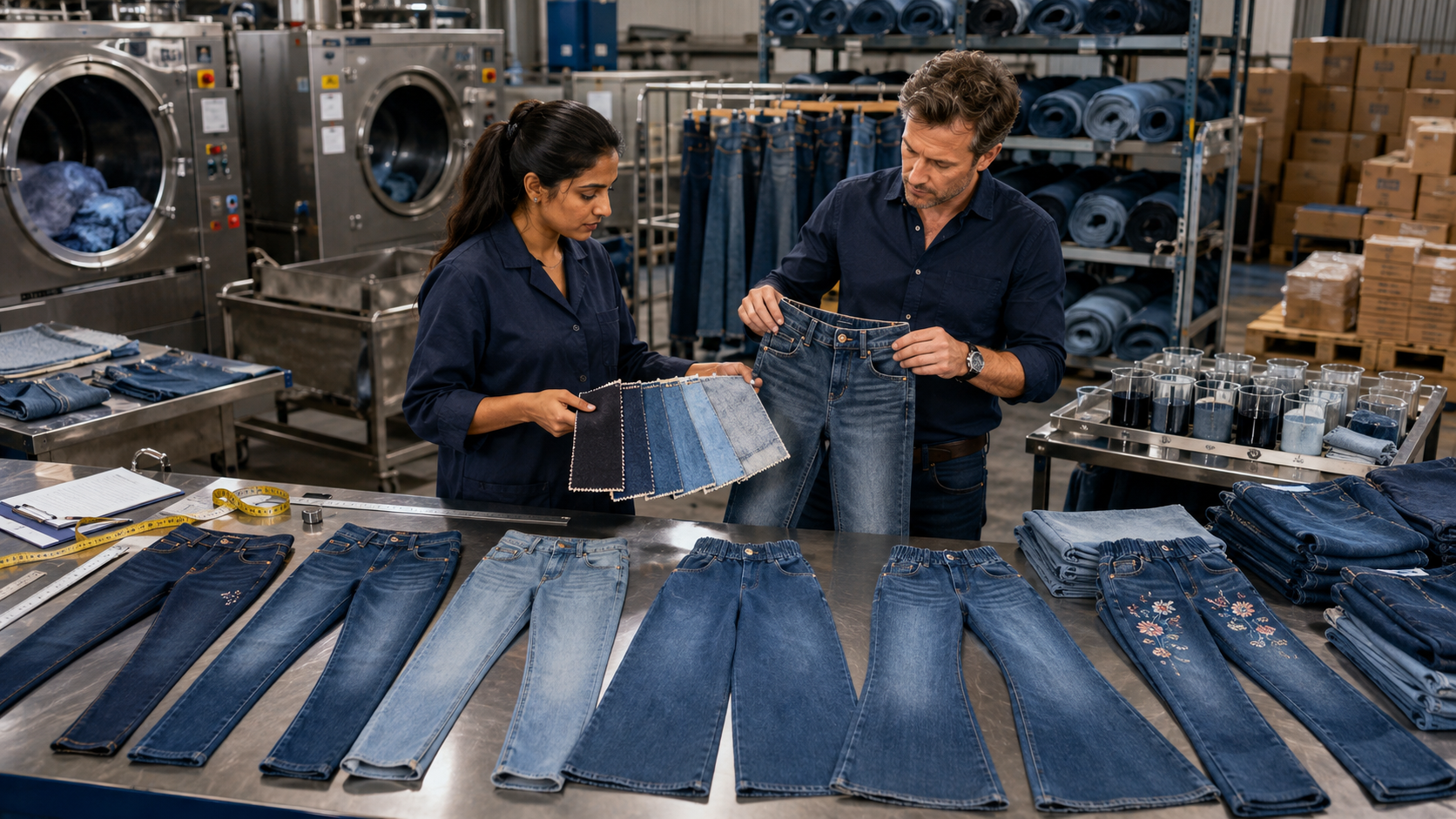
Girls’ jeans pant manufacturers develop denim bottoms for brands, retailers, wholesalers, and private-label buyers. Buyers should compare denim composition, fabric weight, stretch, washes, fit, sizing, construction, customization, sampling, quality control, minimum orders, and delivery terms before choosing a production partner.
Understanding Girls’ Jeans Manufacturing and Sourcing Requirements
Girls’ jeans pant manufacturers produce denim bottoms for clothing brands, retailers, wholesalers, importers, department stores, and online businesses. Their services may include fabric sourcing, pattern development, sampling, size grading, cutting, sewing, washing, private labeling, quality inspection, packaging, and export support.
Choosing the right girls’ jeans pant manufacturer requires more than comparing prices. Girls’ jeans should fit correctly, support movement, feel comfortable, and maintain their appearance after regular wear and washing. They must also match the buyer’s design, quality level, target price, and seasonal plan.
Denim production can involve several technical steps. Fabric weight, stretch percentage, wash treatment, shrinkage, hardware, stitching, and fit can all affect the finished garment. Buyers should define these details before requesting a final quotation.
Why the Right Denim Manufacturer Matters
Jeans may appear simple, but their construction requires careful control. Two pairs can use similar blue denim while feeling completely different because of their fabric composition, weave, stretch, wash, pattern, and finishing.
A girls’ jeans manufacturing project may involve:
- Denim fabric
- Pocketing fabric
- Waistband construction
- Belt loops
- Zippers
- Buttons
- Rivets
- Elastic adjusters
- Topstitching thread
- Brand labels
- Care labels
- Leather or fabric patches
- Wash treatments
- Pressing
- Folding and packaging
Each component affects cost, fit, comfort, durability, and appearance. A manufacturer should understand how these materials work together before bulk production begins.
Minmax Textile is one possible custom clothing manufacturer for brands and wholesale buyers. As with any supplier, buyers should review its denim capabilities, samples, production terms, communication, and quality procedures before placing an order.
What Do Girls’ Jeans Pant Manufacturers Do?
Girls’ jeans pant manufacturers turn a product idea into a finished garment that can be produced in bulk. The factory may work from a technical pack, sketch, measurement chart, reference sample, product photograph, or written description.
Depending on the supplier, manufacturing services may include:
- Reviewing the product concept
- Recommending suitable denim
- Sourcing fabric and trims
- Developing patterns
- Producing development samples
- Adjusting the fit
- Grading patterns into different sizes
- Cutting denim panels
- Sewing the jeans
- Applying wash treatments
- Adding embroidery or patches
- Attaching buttons, rivets, and labels
- Inspecting finished garments
- Packing the order
- Preparing export documents
- Coordinating shipment
Some factories offer cut-and-sew services only. Others provide full-package manufacturing from fabric sourcing through final packing.
Buyers can review a supplier’s garment manufacturing company profile to learn about its general capabilities. However, they should still request specific information about denim equipment, wash facilities, sample development, size grading, and quality control.
OEM Production
Original equipment manufacturing, or OEM, follows the buyer’s detailed product specifications. The buyer normally provides the design, measurements, fabric requirements, wash reference, trims, labels, and packaging instructions.
OEM production offers greater product control. It also requires a complete technical pack and careful approval at every stage.
ODM Production
An original design manufacturer, or ODM, may offer existing designs that buyers can modify. Changes might include fabric, colors, washes, labels, pockets, stitching, or packaging.
ODM production can reduce development time, but the product may be less unique than a fully custom design.
Private-Label Production
Private-label production allows businesses to sell jeans under their own brand. The supplier may add woven labels, care labels, size labels, hangtags, barcode stickers, branded patches, and custom packaging.
Buyers interested in this model can examine private-label denim manufacturing before preparing their branding and product specifications.
Popular Styles of Girls’ Jeans
Girls’ denim can be produced in many shapes and fits. The right style depends on the target age group, fashion direction, comfort requirements, season, and customer preferences.
Common styles include:
- Straight-leg jeans
- Slim-fit jeans
- Skinny jeans
- Bootcut jeans
- Wide-leg jeans
- Flared jeans
- Mom-fit jeans
- Boyfriend jeans
- Relaxed-fit jeans
- Pull-on jeans
- Jeggings
- Cargo jeans
- Carpenter jeans
- Cropped jeans
- Ankle-length jeans
- High-waisted jeans
- Mid-rise jeans
- Low-rise jeans
- Elastic-waist jeans
- Distressed fashion jeans
- Embroidered jeans
- Printed denim pants
- Denim joggers
- Denim overalls
Brands developing a wider collection may combine jeans with products from a wholesale girls’ clothing manufacturer. Related tops, jackets, sweaters, skirts, shorts, and trousers can use coordinated colors and branding.
Straight-Leg Jeans
Straight-leg jeans maintain a fairly consistent width from the thigh toward the hem. This practical shape can work for casualwear, school outfits, and everyday collections.
The manufacturer should balance the hip, thigh, knee, and hem measurements. The jeans must provide enough movement without appearing oversized.
Skinny and Slim Jeans
Slim and skinny jeans usually require denim with controlled stretch. The fabric should recover after movement and maintain its shape during wear.
Poor recovery may cause loose knees, a stretched waistband, or an uneven fit. Buyers should review the fabric’s stretch and recovery before approving production.
Wide-Leg and Flared Jeans
Wide-leg and flared designs use more fabric than narrow styles. The drape, fabric weight, inseam, and hem width can strongly affect the final appearance.
The pattern should remain balanced across all sizes. A flare that looks correct in one sample size may need careful adjustment for smaller or larger sizes.
Pull-On Jeans and Jeggings
Pull-on jeans may use a full elastic waistband instead of a traditional fly. Jeggings combine the appearance of denim with the stretch and close fit of leggings.
These styles can provide comfort and easy dressing. However, the waistband must offer suitable stretch without becoming loose after repeated use.
Fashion and Decorated Jeans
Fashion jeans may include embroidery, prints, patches, sequins, appliqué, contrast panels, released hems, distressing, or decorative stitching.
Every decorative part should be suitable for the intended age group. Buyers should clearly identify placement, size, color, attachment method, and required testing.
Selecting the Right Denim Fabric
Fabric selection is one of the most important parts of jeans production. It affects fit, movement, wash results, durability, appearance, and cost.
Common denim options include:
- Rigid cotton denim
- Cotton-spandex denim
- Cotton-polyester denim
- Cotton-polyester-spandex denim
- Lightweight denim
- Midweight denim
- Heavy denim
- Stretch denim
- Super-stretch denim
- Colored denim
- Black denim
- Slub denim
- Recycled-fiber denim
- Knit denim
A useful denim specification should include:
- Fiber composition
- Fabric weight
- Stretch direction
- Stretch percentage
- Recovery
- Weave
- Base color
- Surface texture
- Shrinkage expectations
- Wash treatment
- Approved physical reference
Terms such as “soft denim” or “premium jeans fabric” are not precise enough for manufacturing. Buyers should approve a physical swatch before sample development.
Rigid Denim
Rigid denim contains little or no stretch. It can create a traditional, structured appearance. However, the pattern must include enough room for movement.
This fabric may work for straight, relaxed, carpenter, or wide-leg jeans. It may feel less suitable for very close-fitting designs.
Stretch Denim
Stretch denim usually includes an elastic fiber that allows the garment to move with the wearer. It is often used for slim jeans, skinny jeans, jeggings, and fitted styles.
Buyers should not consider stretch alone. Recovery is also important. Good recovery helps the fabric return to its original shape after it has been stretched.
Fabric Weight
Denim weight affects structure, comfort, drape, and seasonal use. Lightweight denim may be suitable for warm climates and relaxed styles. Heavier denim can provide a firmer shape but may feel too stiff for young children.
There is no single weight that suits every design. Buyers should compare physical fabric options and consider the target climate, age group, fit, wash, and retail price.
Denim Washes and Finishing Options
Wash treatments give denim its final color, softness, texture, and worn appearance. The same base fabric can produce several different looks after washing.
Possible treatments include:
- Rinse wash
- Garment wash
- Enzyme wash
- Stone wash
- Acid-style wash
- Bleach wash
- Vintage wash
- Dark wash
- Medium wash
- Light wash
- Tinted wash
- Softener finish
- Whiskering
- Hand sanding
- Fading
- Localized abrasion
- Laser finishing
- Distressing
A broader custom denim manufacturing guide can help buyers understand how fabric, fit, washing, trims, sampling, and bulk production connect.
Wash Approval
Color descriptions such as “medium blue” or “vintage blue” can be interpreted differently. Buyers should provide a physical wash reference, approved sample, or clear color standard.
The approved sample should become the main reference for bulk production. Buyers should also agree on an acceptable shade range because denim wash results can vary between production batches.
Shrinkage After Washing
Denim may change in length, width, texture, and color during washing. The manufacturer should consider expected shrinkage when developing the pattern.
Buyers should measure samples before and after the required wash test. This helps confirm whether the final garment will remain within the approved measurement tolerance.
Distressing and Abrasion
Distressed jeans may include faded areas, surface abrasion, cut details, or repaired sections. These effects should be carefully controlled.
The technical pack should identify the exact location, size, shape, and appearance of every distressed detail. Heavy distressing should not weaken critical areas or create unsuitable openings.
Sizing and Fit for Girls’ Jeans
Accurate sizing is essential for children’s denim. Age labels alone may not provide enough guidance because body proportions and brand fits can differ.
A girls’ jeans measurement chart may include:
- Waist
- Relaxed waistband
- Extended waistband
- Hip
- Front rise
- Back rise
- Thigh
- Knee width
- Leg opening
- Inseam
- Outseam
- Fly length
- Waistband height
- Pocket dimensions
- Pocket placement
- Belt-loop length
The buyer should explain how every measurement is taken. A diagram can prevent confusion about whether a point is measured flat, around the garment, along a seam, or straight across.
Size Grading
Size grading adjusts a pattern across the complete size range. Waist, hip, rise, thigh, inseam, knee, and hem measurements may require different grading rules.
A small pair of jeans should not simply be enlarged equally in every direction. The manufacturer must consider changes in body proportions as the age range increases.
Buyers should approve a base-size fit sample first. They may then request size-set samples to review the grading across smaller, middle, and larger sizes.
Waistband Options
Possible waistband constructions include:
- Fixed waistband
- Stretch waistband
- Full elastic waistband
- Back elastic waistband
- Internal adjustable elastic
- Rib-knit waistband
- Drawstring waistband
- Hook-and-bar closure
- Snap closure
- Button closure
Adjustable waistbands can help support different body shapes. However, elastic, buttons, and internal openings must be secure and suitable for the target age group.
Comfort and Movement
Jeans should allow the wearer to sit, bend, walk, and play comfortably. Fit reviews should consider:
- Waist pressure
- Hip room
- Rise depth
- Thigh movement
- Knee movement
- Fabric stretch
- Seam comfort
- Hardware placement
- Pocket access
- Garment weight
A visually attractive fit may still be unsuitable if it restricts movement. Physical fitting provides more useful information than measurements alone.
Construction Details That Affect Quality
Quality depends on fabric, workmanship, hardware, washing, and finishing. Buyers should inspect both the outside and inside of the jeans.
Important construction points include:
- Straight seams
- Consistent stitch density
- Secure side seams
- Strong inseams
- Balanced leg panels
- Even waistband attachment
- Reinforced pocket openings
- Secure belt loops
- Smooth zipper movement
- Firm button attachment
- Proper rivet placement
- Clean bar tacks
- Accurate topstitching
- Matching thread colors
- Correct label placement
- Clean internal finishing
- Equal leg lengths
- Balanced wash effects
High-stress areas may require reinforcement. These areas can include pocket openings, the bottom of the fly, belt loops, and the ends of the waistband.
Pockets
Girls’ jeans may use front scoop pockets, coin pockets, patch pockets, cargo pockets, or decorative false pockets.
Pocket placement can change the garment’s appearance. Buyers should provide measurements for pocket height, width, angle, and distance from the seams.
Zippers, Buttons, and Rivets
Hardware should function correctly and remain securely attached. The color and finish should also match the approved design.
Buyers should test:
- Zipper movement
- Zipper locking
- Button attachment
- Buttonhole size
- Rivet security
- Surface finish
- Sharp edges
- Corrosion or color transfer
Hardware requirements should be finalized before bulk production because custom pieces may require extra sourcing time.
Topstitching
Topstitching is a visible part of denim design. It may appear along pockets, side seams, waistbands, yokes, hems, and belt loops.
The technical pack should identify thread color, stitch type, number of rows, and required placement. Uneven topstitching can make an otherwise acceptable pair of jeans look poorly finished.
Safety and Age-Appropriate Design
Children’s clothing must meet the requirements of the destination market. Buyers are responsible for identifying the legal, retailer, labeling, and testing standards that apply to their products.
Details that may require review include:
- Small detachable parts
- Loose buttons
- Rivets
- Sharp hardware
- Drawstrings
- Long cords
- Decorative beads
- Sequins
- Metal trims
- Zipper components
- Chemical requirements
- Flammability rules
- Fiber-content labeling
- Care instructions
A trim should not be approved only because it looks attractive. It should also be secure, practical, and appropriate for the intended age group.
The buyer should provide the required test protocol before fabric and trim approval. Manufacturers should not be expected to determine every rule for every sales market.
Customization and Private-Label Options
Custom details allow jeans to reflect the buyer’s brand identity and target customer.
Available options may include:
- Custom denim composition
- Buyer-selected washes
- Custom colors
- Contrast topstitching
- Embroidery
- Printed artwork
- Patches
- Appliqué
- Decorative pockets
- Custom buttons
- Branded rivets
- Custom zipper pulls
- Woven labels
- Printed care labels
- Size labels
- Waistband labels
- Back patches
- Hangtags
- Barcode stickers
- Individual packaging
- Retail-ready cartons
Businesses developing a new label can review this guide to starting a private-label clothing line before preparing their order.
Brand artwork should include exact dimensions, colors, placement, and application methods. Buyers should approve physical examples of branded buttons, labels, patches, and embroidery before production.
Samples, MOQs, and Production Planning
Samples allow buyers to review the product before committing to a bulk order. Jeans may require more than one sample because fit and wash treatments can affect each other.
Common sample stages include:
- Development sample: Reviews the first interpretation of the design.
- Fit sample: Checks measurements, shape, comfort, and movement.
- Wash sample: Confirms color, fading, softness, and surface effects.
- Size-set sample: Reviews grading across selected sizes.
- Trim sample: Confirms buttons, rivets, labels, patches, and thread.
- Pre-production sample: Represents the final approved product.
- Shipment sample: Shows a finished garment selected from bulk production.
Not every order needs every stage. However, custom washes, wide size ranges, special hardware, and detailed decorations may require additional approvals.
Minimum Order Quantity
Minimum order quantity, or MOQ, is the smallest order a manufacturer accepts. It may apply per design, denim fabric, wash, color, or size range.
MOQ can be affected by:
- Fabric availability
- Custom dyeing
- Wash treatment
- Number of designs
- Number of colors
- Size breakdown
- Custom hardware
- Embroidery
- Labels
- Packaging
- Factory capacity
Buyers should ask exactly what the stated MOQ covers. A total order spread across several styles and washes may not meet the required quantity for each variation.
Pricing Factors
The price of girls’ jeans may depend on:
- Denim composition
- Fabric weight
- Fabric consumption
- Stretch properties
- Wash complexity
- Pattern and fit
- Size range
- Order volume
- Pocket construction
- Stitching details
- Zippers and buttons
- Rivets
- Embroidery or printing
- Distressing
- Custom labels
- Packaging
- Testing requirements
- Shipping terms
The lowest quotation may not include the same fabric, wash, trims, packaging, or quality checks as a higher quotation. Buyers should compare suppliers using identical specifications.
Production Schedule
The total schedule may include:
- Product review
- Fabric sourcing
- Pattern development
- Fit sampling
- Wash trials
- Sample revisions
- Size-set approval
- Bulk fabric preparation
- Cutting and sewing
- Washing
- Finishing
- Inspection
- Packing
- Shipping
Buyers should not plan a retail launch based only on sewing time. Sample revisions, wash development, transportation, customs clearance, and local delivery must also be considered.
Quality Control for Bulk Girls’ Jeans
Quality control should begin before fabric is cut. A final inspection cannot fully correct an issue that affects an entire production run.
Before bulk production, buyers should approve:
- Technical pack
- Measurement chart
- Grading rules
- Denim fabric
- Fabric weight
- Stretch and recovery
- Shrinkage expectations
- Wash standard
- Thread colors
- Zippers
- Buttons and rivets
- Labels and patches
- Artwork
- Packaging
- Pre-production sample
During manufacturing, checks may cover cutting accuracy, seam construction, measurements, hardware, stitching, wash consistency, and workmanship.
A final inspection may examine:
- Garment measurements
- Waistband shape
- Leg balance
- Inseam and outseam
- Stitch condition
- Pocket placement
- Belt-loop attachment
- Zipper function
- Button and rivet security
- Wash shade
- Distressing placement
- Label accuracy
- Loose threads
- Stains
- Holes or damage
- Folding and packaging
- Carton quantity
Buyers can use a pre-shipment clothing quality guide when preparing their inspection requirements.
The inspection may be completed by the manufacturer’s quality team, the buyer’s representative, or an independent inspection company. The best approach depends on the order size, product complexity, and risk level.
How to Compare Girls’ Jeans Pant Manufacturers
A reliable denim supplier should provide clear information, realistic schedules, physical samples, and written production terms.
Use this checklist when comparing manufacturers:
- Experience producing children’s denim
- Access to suitable denim fabrics
- Pattern-development ability
- Size-grading knowledge
- Wash-development experience
- Stretch and recovery control
- Hardware-sourcing options
- Custom branding services
- Quality-control procedures
- Clear MOQ requirements
- Detailed quotations
- Realistic lead times
- Export and packaging support
- Consistent communication
- Written sample approvals
Buyers may also compare jeans production with related bottoms from a girls’ trousers and leggings supplier when planning a broader collection.
Questions to Ask a Manufacturer
Before ordering, buyers should ask:
- Have you produced similar girls’ jeans?
- Which denim fabrics can you source?
- Can you match a physical wash reference?
- Can you work from a technical pack?
- How do you test fabric stretch and recovery?
- How do you control shrinkage?
- Which sample stages do you recommend?
- Can you grade the pattern across our size range?
- What does the MOQ apply to?
- Can you source custom buttons and rivets?
- Can you add private labels and packaging?
- Which quality checks occur during production?
- Can laboratory testing be arranged?
- What is included in the quotation?
- How long will sampling and production take?
- Which shipping terms are available?
- How are defects or shortages handled?
- How are revisions and approvals recorded?
Every shortlisted supplier should receive the same specifications and questions. This makes the answers, prices, and production capabilities easier to compare.
Common Girls’ Jeans Sourcing Mistakes
Choosing a Supplier Based Only on Price
A low price may reflect lighter fabric, simpler construction, basic hardware, fewer wash processes, weaker packaging, or limited inspection. Compare the full specification instead of comparing only unit prices.
Approving Denim Through Photographs
Pictures cannot accurately show weight, stretch, softness, texture, recovery, or wash quality. Request physical swatches and garment samples whenever possible.
Using an Incomplete Measurement Chart
A chart that lists only waist, hip, and length does not fully define the fit. Include rise, thigh, knee, hem, inseam, waistband, and pocket measurements.
Ignoring Stretch Recovery
Highly stretchy denim may feel comfortable during fitting but lose its shape after wear. Test how well the fabric returns to its original dimensions.
Skipping Wash Tests
Denim may shrink, fade, bleed, or change texture after washing. Review test results and measure the garment after the required care process.
Using Unclear Wash Descriptions
Terms such as “light blue” or “vintage wash” are subjective. Approve a physical standard and define an acceptable shade range.
Checking Only One Size
The base-size sample may fit correctly while smaller or larger sizes have grading problems. Review selected sizes across the planned range.
Approving Hardware Only by Appearance
Buttons, rivets, snaps, and zippers must be tested for function and attachment. Attractive hardware can still cause problems if it is sharp, loose, or difficult to use.
Making Changes After Production Begins
Late changes to denim, washes, pockets, hardware, labels, or packaging can affect price and delivery. Finalize all details before bulk approval.
Leaving Too Little Time for Delivery
Factory completion is not the same as arrival at the buyer’s warehouse. Include inspection, packing, freight, customs, and inland transportation in the schedule.
A Practical Ordering Process
- Define the product. Choose the jeans style, age group, fit, denim composition, wash, colors, size range, and estimated quantity.
- Prepare the technical details. Provide measurements, construction notes, pocket designs, stitching, hardware, labels, artwork, and packaging instructions.
- Shortlist manufacturers. Compare denim experience, sample capabilities, wash options, size grading, quality systems, and communication.
- Request comparable quotations. Send the same product information to every supplier.
- Approve the denim. Review fabric weight, composition, stretch, recovery, color, texture, and shrinkage.
- Develop samples. Check the fit, measurements, wash, pockets, hardware, stitching, branding, and comfort.
- Review the size set. Confirm that grading remains balanced across the planned size range.
- Approve commercial terms. Confirm quantity, size breakdown, price, schedule, payment terms, packaging, and shipping terms.
- Monitor bulk production. Request progress reports and record every approved change in writing.
- Inspect the completed order. Compare finished jeans with the approved sample, wash standard, and technical pack.
- Review shipping documents. Confirm carton quantities, packing lists, commercial invoices, and other required records before shipment.
Frequently Asked Questions
What do girls’ jeans pant manufacturers produce?
Girls’ jeans pant manufacturers produce denim bottoms for brands, retailers, wholesalers, and private-label businesses. Products may include straight, slim, skinny, bootcut, wide-leg, pull-on, embroidered, distressed, and stretch jeans.
Which denim is best for girls’ jeans?
The best denim depends on the design, age group, climate, fit, and target price. Rigid denim can provide structure, while stretch denim may offer more movement for close-fitting styles.
Can manufacturers create custom denim washes?
Many denim manufacturers can develop dark, medium, light, vintage, enzyme, stone, faded, or distressed finishes. Available treatments depend on the supplier’s facilities and production partners.
Can buyers add private labels to girls’ jeans?
Yes. Available options may include woven labels, care labels, size labels, branded buttons, custom rivets, back patches, hangtags, barcode stickers, and branded packaging.
What affects the MOQ for girls’ jeans?
MOQ can depend on fabric availability, wash treatment, number of styles, colors, sizes, custom hardware, labels, decoration, and packaging.
How can buyers check the quality of girls’ jeans?
Buyers should approve the fabric, fit, wash, measurements, hardware, stitching, labels, and pre-production sample. They should also arrange suitable inspections during or after production.
Why is a wash sample important?
A wash sample shows the expected shade, softness, fading, shrinkage, and surface appearance. It gives the manufacturer and buyer a physical standard for bulk production.
How long does girls’ jeans production take?
There is no universal production time. The schedule depends on fabric sourcing, wash development, sample revisions, order quantity, design complexity, factory capacity, inspection, and packaging.
Prepare Your Girls’ Jeans Order Carefully
Choosing among girls’ jeans pant manufacturers begins with a detailed product plan. Buyers should define the style, denim, fit, wash, size range, hardware, branding, order quantity, quality requirements, packaging, and delivery destination.
Physical samples are essential for reviewing denim. Buyers should examine fabric weight, stretch, recovery, fit, movement, wash shade, shrinkage, stitching, pockets, buttons, rivets, labels, and packaging before approving bulk production.
Brands, retailers, wholesalers, importers, and private-label businesses can request a girls’ jeans manufacturing quotation after preparing their designs, estimated quantities, size range, denim preferences, wash references, branding requirements, and target delivery schedule. Comparing several qualified manufacturers with the same specifications can support a more informed sourcing decision.


3 thoughts on “Girls’ Jeans Pant Manufacturers: A Complete Sourcing Guide”
Here you are
Great post,Thanks for sharing
Thanks for your feedback.