
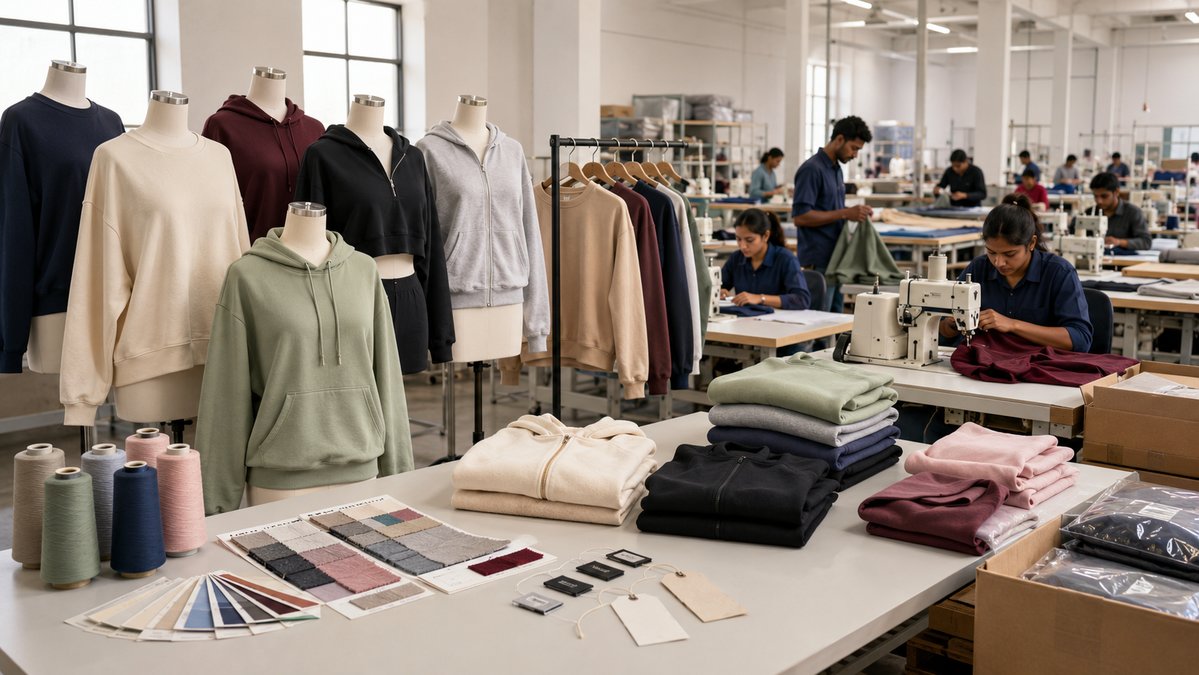
A women’s sweatshirt exporter, manufacturer, and wholesaler handles fabric sourcing, production, branding, and bulk shipping for retailers and brands worldwide. Buyers should check fabric quality, sizing accuracy, MOQs, sample turnaround, export documentation, and shipping experience before committing to a supplier.
Why Sweatshirts Remain a Core Category for Fashion Buyers
Sweatshirts have moved well past their gym-wear origins. They now sit comfortably in loungewear, streetwear, athleisure, and even elevated casual collections, which is why retailers across nearly every market keep sweatshirts as a year-round staple rather than a seasonal add-on.
That steady demand makes sourcing decisions matter. A brand needs a partner who can deliver consistent fabric quality, accurate sizing, and clean branding at a workable price, whether ordering 100 pieces for a new private-label launch or 10,000 units for an established wholesale account.
This guide breaks down what a women’s sweatshirt manufacturer, exporter, and wholesaler actually does, the styles and fabrics worth knowing, and how to evaluate a supplier before placing your first order.
The Role of a Women’s Sweatshirt Manufacturer, Exporter, and Wholesaler
These three roles often overlap, but each serves a slightly different function in the supply chain.
- Manufacturer: Produces the sweatshirts, handling fabric sourcing, cutting, sewing, printing or embroidery, and finishing.
- Exporter: Manages international shipping, customs documentation, and compliance for cross-border orders.
- Wholesaler: Sells finished sweatshirts in bulk, often from existing stock or through a manufacturing partner, without necessarily running the production line itself.
Some companies, including manufacturers like Minmax Textile, operate across all three functions, offering production, private label branding, and export shipping under one roof. This setup can simplify sourcing for buyers who would otherwise need to coordinate separately with a factory, a freight forwarder, and a customs agent.
Manufacturer vs. Exporter vs. Wholesaler
| Role | Primary Function | Best For |
|---|---|---|
| Manufacturer | Produces garments from raw materials | Brands needing custom design or private label production |
| Exporter | Handles international shipping and customs | Buyers importing bulk orders across borders |
| Wholesaler | Sells existing stock in bulk quantities | Retailers needing fast turnaround without custom development |
Popular Women’s Sweatshirt Styles
A well-rounded women’s pullover manufacturer should offer a range of styles to fit different retail categories and customer preferences.
- Crew neck sweatshirts – classic, versatile, and a steady seller across nearly every market
- Oversized sweatshirts – strong demand in the USA, UK, Australia, and Canada, especially among younger customers
- Cropped sweatshirts – popular for athleisure and layered streetwear looks
- Zip-up sweatshirts – practical for layering and easy to brand with front zip pulls or chest logos
- Hooded sweatshirts – a top category for a women’s hooded sweatshirt manufacturer, used in both streetwear and performance lines
- Fleece sweatshirts – heavier weight, suited to colder climates like the UK, Germany, the Netherlands, and Canada
- Sports sweatshirts – performance-oriented fabrics and fits, often used for activewear and athleisure brands
Buyers in warmer regions such as the UAE, Saudi Arabia, and Qatar often favor lighter-weight sweatshirts for indoor, air-conditioned wear. At the same time, retailers in cooler climates tend to favor heavier fleece and brushed-fabric options.
Common Fabrics Used in Sweatshirt Manufacturing
Fabric choice affects warmth, softness, durability, and price, so it’s worth understanding the main options before finalizing a style.
- Cotton – breathable and soft, a common base fabric for casual sweatshirts
- French terry – lightweight with a looped inner texture, good for transitional weather
- Fleece – brushed on the inside for extra warmth, ideal for colder markets
- Polyester blends – adds durability, shape retention, and moisture-wicking properties
- Brushed fabric – softened finish that improves comfort against the skin
- Recycled materials – recycled cotton and polyester blends are gaining traction among sustainability-focused brands in the USA, UK, Germany, and the Netherlands
Many manufacturers blend cotton with polyester to balance softness, durability, and cost. A heavier GSM (grams per square meter) generally means a warmer, more substantial sweatshirt, while a lighter GSM suits milder climates or layering.
Fabric Questions to Ask Before Bulk Production
- What is the exact fabric composition and GSM weight?
- Is the fabric pre-shrunk and tested for colorfastness?
- What is the brushing or fleece-back finish like, and can a swatch be provided?
- Does the fabric meet any compliance standards required in your target market?
Private Label and OEM Sweatshirt Production
Private label and OEM options give brands different levels of control over design and development.
Private label sweatshirts are built from a manufacturer’s existing patterns and styles, customized with your branding, labels, and packaging. This route is faster and typically comes with lower MOQs, making it a practical starting point for newer brands or smaller retailers.
OEM sweatshirt manufacturing involves producing garments from your own designs, tech packs, and specifications. This gives full creative control over fit, fabric, and detailing but usually requires higher minimum order quantities and longer lead times.
Buyers scaling a brand often start with private label styles to test the market, then move into OEM production once order volumes justify the additional development time and cost.
Custom Colors, Prints, Embroidery, and Branding
A reliable custom clothing manufacturer should offer several ways to personalize sweatshirts for your brand.
- Colors: Pantone matching or dyeing to a submitted swatch
- Prints: Screen printing, puff printing, or all-over sublimation depending on fabric type
- Embroidery: Logos, text, or decorative stitching on the chest, sleeve, or hood
- Labels: Woven labels, printed neck labels, size tags, and care labels
- Drawstrings and trims: Custom drawstring colors, ribbing, and zipper pulls
- Sizing: Grading to US, UK, EU, or Australian size standards, or a buyer’s own size chart
- Packaging: Polybags, branded boxes, hang tags, and folding specifications for retail-ready presentation
Sizing accuracy matters more than buyers sometimes expect. A size Large in the US doesn’t always match a size Large in the UK or Australia, so sharing a clear size chart upfront helps the factory grade patterns correctly the first time.
Fabric Weight, Softness, Stitching, and Fit
A quality sweatshirt should feel substantial without being stiff, and construction details often reveal how well it will hold up over repeated washes.
- Fabric weight – should match the agreed GSM and feel consistent with the intended season and use
- Softness and hand-feel – brushed or fleece-backed fabric should feel smooth, not scratchy or overly stiff.
- Ribbing – cuffs, hem, and neckline ribbing should have good stretch and recovery.
- Stitch consistency – even, secure stitching along seams, hoods, and pockets
- Print and embroidery durability – designs should hold up after multiple wash cycles without cracking or fraying.g
- Consistent measurements – chest, length, sleeve, and hood proportions should match the spec sheet across the full size range.
Requesting a wash-test sample, not just an unwashed sample, gives a more accurate sense of how the fabric and print will perform over time.
Minimum Order Quantities, Samples, and Pricing
MOQs and pricing depend on production type, fabric complexity, and customization level.
Typical industry ranges (these vary by supplier):
- Private label MOQ: often 50 to 300 pieces per style/color
- OEM/custom MOQ: often 300 to 1,000+ pieces per style
- Sample lead time: usually 7 to 14 days
- Bulk production lead time: usually 30 to 45 days, depending on fabric availability and order size
Steps to Get an Accurate Quotation
- Share the sweatshirt style, fabric preference, and target quantity
- Provide a size chart or reference sample
- Confirm printing, embroidery, and labeling requirements
- Ask for a cost breakdown covering fabric, trims, labor, printing, and packaging
- Request sample and bulk lead times separately, along with monthly production capacity
Comparing total landed cost, including shipping and duties, gives a more accurate picture than comparing unit price alone.
Quality Control and Responsible Manufacturing
A dependable manufacturer builds quality checks into multiple stages of production rather than inspecting only at the end.
- Raw material inspection for fabric and trims before cutting
- In-line inspection during sewing and printing to catch issues early
- Pre-shipment inspection covering measurements, stitching, and packaging
- AQL-based random sampling to confirm the batch meets agreed quality standards
Responsible manufacturing continues to matter more to buyers in the USA, UK, Australia, Germany, and the Netherlands, where customers increasingly ask about fair labor practices, factory conditions, and environmental impact. Asking a supplier about certifications, audit history, and waste management is a reasonable step before signing a production agreement.
Export Documentation, Packaging, and Shipping
For international buyers, export readiness is just as important as production quality. A women’s sweatshirt exporter should be able to handle the paperwork and logistics involved in cross-border shipments.
Common export documents include:
- Commercial invoice and packing list
- Certificate of origin
- Bill of lading or airway bill
- Fabric composition and care labeling compliance documents
- Any additional certificates required by the destination country
Packaging considerations:
- Individual polybags with size stickers for retail-ready orders
- Master cartons labeled with style, color, size breakdown, and quantity
- Compliance with any labeling requirements specific to the importing country, such as fiber content disclosure in the EU or country-of-origin marking in the USA and Canada
Shipping method usually depends on the order size and timeline. Sea freight remains the most economical choice for large bulk orders, while air freight suits smaller or time-sensitive shipments. Buyers in the UAE, Saudi Arabia, and Qatar often work with regional freight forwarders familiar with local customs clearance, which can noticeably shorten delivery times.
How to Choose a Reliable Wholesale Women’s Sweatshirt Supplier
Checklist for evaluating suppliers:
- Do they have direct experience manufacturing sweatshirts, not just general apparel?
- Can they share references or examples from past private label work?
- Are MOQs, pricing, and lead times clearly explained upfront?
- Is their sample process organized and responsive?
- Can they confirm monthly production capacity to match your order volume?
- Do they have export experience shipping to your specific country?
- Do they communicate clearly and answer technical questions in detail?
Practical Tips Before Placing a Bulk Order
- Request a physical sample, ideally washed once, to check fabric behavior and print durability.
- Check fabric composition and weight against the agreed spec sheet, not just a general description.
- Confirm size charts and measurements with a measuring tape rather than relying on visual estimates.
- Review printing and embroidery quality closely, checking edges, color accuracy, and stitch density.
- Compare quotations and MOQs across suppliers, noting what’s included versus billed separately.
- Check monthly production capacity to confirm the factory can handle your order without delaying your delivery window.
- Confirm export packaging and delivery terms in writing, including Incoterms, labeling requirements, and expected transit times.
Frequently Asked Questions
What is the typical MOQ for private label sweatshirts? Private label MOQs commonly range from 50 to 300 pieces per style and color, though this varies by manufacturer and fabric type.
How long does bulk sweatshirt production usually take? Bulk production typically takes 30 to 45 days after sample approval, depending on fabric availability and order size.
What fabric works best for colder climates? Fleece and heavier brushed-back cotton blends are commonly used for colder markets like the UK, Germany, and Canada, offering more warmth than lightweight French terry.
Can a manufacturer handle both production and export shipping? Yes, many manufacturers, including full-service suppliers, handle production, private label branding, and export documentation together, which simplifies coordination for international buyers.
Is it possible to request a washed sample before bulk production? Yes, and it’s a good idea. A washed sample shows how the fabric, ribbing, and print will hold up after regular use, which an unwashed sample can’t fully demonstrate.
Move Forward with a Trusted Sweatshirt Supply Partner
Sourcing women’s sweatshirts at scale comes down to three things: consistent production quality, accurate sizing, and dependable export logistics. Whether you’re a fashion brand launching a new private label line, a retailer restocking seasonal inventory, or an importer building out a wholesale catalog, taking time to review samples, confirm measurements, and compare quotations will save time and reduce costly reorders.
Manufacturers like Minmax Textile support brands and wholesale buyers with private-label and OEM sweatshirt production, as well as export documentation and shipping coordination for international orders. If you’re ready to source your next sweatshirt collection, reach out with your target style, fabric preference, and order quantity, and request a sample to evaluate quality before committing to bulk production.


